

2026 Housing Fireworks
Why Sellers Are Panicking, Buyers Are Walking, and the Market Is Finally Cracking

Written by Rebel Capitalist AI | Supervision and Topic Selection by George Gammon | December 11, 2025

If you wanted a preview of the 2026 housing market, today’s data dump delivered it with fireworks...and not the good kind.
After speaking with housing expert Melody Wright, George unpacked a series of indicators that paint a picture that’s messy, counterintuitive, and...if you’re a buyer...potentially the best news you’ve heard in years.
The narrative housing bulls have clung to for the past 24 months is falling apart.
Sellers are delisting homes at a record pace. Cancellations are surging. Foreclosures are rising. And pricing dynamics between new and existing homes have flipped upside down for the first time in decades.
Meanwhile, mortgage rates have already come down by nearly 80 basis points this year...and demand still hasn’t returned.
The housing market isn’t frozen anymore. It’s cracking. And once psychology shifts, it can go from slow drip to waterfall almost overnight.
Let’s break it down.
Sellers Are Giving Up...Fast
The most eye‑opening data point came from Realtor.com: home delistings are up 45.5% year‑to‑date, and nearly 38% compared to October 2024.
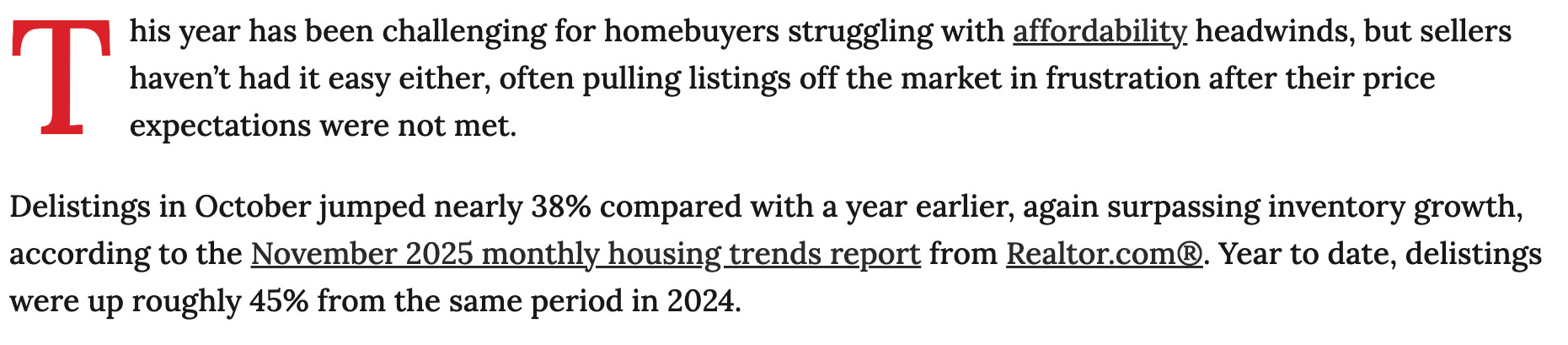
Sellers are putting homes on the market at last year’s fantasy prices, getting zero traction, and then retreating when reality doesn’t cooperate.
It’s the classic psychology of a turning market. Sellers view prices through the rearview mirror: “My neighbor got $500,000 in 2024...so that’s what my home is worth.”
Buyers, meanwhile, are looking through the windshield. They’re seeing:
Builders slashing prices by tens of thousands.
Incentives everywhere.
Higher insurance costs.
Rising property taxes.
A weakening labor market.
They don’t care what the neighbor got. They care about what’s next.
This mismatch is creating an enormous stalemate, and sellers’ refusal to cut prices is turning into widespread delistings. But delistings aren’t a sign of strength...they’re a sign of capitulation delay. Sellers would rather pull the listing than face the reality of a lower offer.
But this doesn’t make the problem go away. It merely postpones the reckoning.
New Home Prices Have Fallen Below Existing Homes
Melody revealed something few analysts have caught: in many markets, new home prices are now lower than comparable existing home prices.
This almost never happens. Historically, new homes command a premium:
New appliances.
New roofs and HVAC.
Builder warranties.
Modern layouts.
But today? Builders are in survival mode. They must move inventory. They don’t have the emotional attachment homeowners have. They’re slashing prices, offering rate buydowns, or throwing in cash credits because sitting on unsold inventory is existential for them.
The result is brutal for existing homeowners. If Lennar is selling a brand‑new house for $450,000, nobody is going to pay $500,000 for the 1990s stucco box across the street.
Once those new‑home comps hit the books, the value of the entire neighborhood adjusts downward.
This is how downturns spread.
Cancellations Are Surging...Buyers Are Walking Away
One of the most alarming stats: 15% of all purchase contracts in October were canceled. But the regional breakdown is even worse.
In San Antonio, 21% of deals fell apart.
These aren’t casual inquiries...these are deals already in process. Inspections done. Financing underway. Closing dates set.
So why are buyers walking?
Melody explained two major reasons.
1. Insurance Shock
First‑time buyers often underestimate the true cost of homeownership. They look only at the mortgage payment. But once they see the final monthly breakdown...including insurance...they realize they can’t afford it.
Insurance has exploded in states like Texas, Florida, and California. A buyer budgeting for a $2,000 monthly payment suddenly discovers their true cost is $2,800.
That’s when they walk.
2. Credit Score Whiplash (Student Loans)
George emphasized another dynamic: many younger buyers had artificially inflated credit scores because student loan payments were paused for years. Once repayment resumed, credit scores dropped sharply, sometimes by 50–100 points.
When lenders repulled credit during the underwriting process, many buyers suddenly no longer qualified.
This wave of cancellations is a preview of what happens when:
Debt burdens rise.
Insurance costs spike.
Real wages stagnate.
Buyers retreat, and sellers eventually must follow.
Foreclosures Are Rising...From Extremely Low Levels
Foreclosures remain historically low, but the direction matters far more than the absolute level. They’re now rising quickly.
This is the start of the curve...not the end of it.
But here’s the key insight: people don’t just lose homes due to rising mortgage rates. They lose them due to rising total cost of ownership.
If your insurance jumps $300 a month…
If your property taxes jump $250 a month…
If your HOA fee rises $100 a month…
It has the exact same effect on your budget as a mortgage payment increasing.
And total cost of ownership is spiking everywhere.
This is the hidden pressure the housing bulls keep ignoring.
Mortgage Rates Already Dropped...Demand Didn’t Return
One of the biggest myths in housing analysis is the idea that lower interest rates automatically restore demand.
But this year proved the opposite.
Mortgage rates fell from 6.93% in January to about 6.19% today...a drop of nearly 80 basis points.
Did demand surge?
Not at all.
In fact, demand continued to deteriorate.
Why? Because interest rates don’t control the economy...they reflect it. Lower rates often mean the economy is worsening. Which means unemployment is rising. Which means people can’t buy homes regardless of rates.
If mortgage rates fall to 4% in 2026, it will likely be because the unemployment rate is 6–7%.
Which scenario supports higher home prices?
Mortgage rates at 6% with 4% unemployment? Or,
Mortgage rates at 4% with 7% unemployment?
It’s not even close.
Housing follows the labor market...not the Fed.
The Reverse Wealth Effect Is the Real Threat
George made a powerful point: asset prices...not wages...are holding up the U.S. economy. Stocks and housing wealth drive consumer spending.
When people feel richer, they spend more.
When they feel poorer, they cut spending quickly.
That’s why the wealth effect is very real...and why the reverse wealth effect is so dangerous.
If home prices fall even 5% nationwide in 2026, the direct economic impact isn’t catastrophic… but the psychological impact could be.
When sellers stop believing the market is stable…
When buyers expect prices to drop further…
When homeowners see their Zillow estimate fall month after month…
They change their behavior.
And behavior drives recessions.
The 2026 Base Case: A Downward Feedback Loop
Put all the variables together and you get a self‑reinforcing cycle:
Prices fall modestly.
Sellers panic and rush to list.
Buyers pull back, expecting further declines.
Cancellations rise, foreclosures increase, and comps deteriorate.
Aggregate demand declines.
The labor market weakens further.
Lower incomes and higher unemployment push more forced sellers into the market.
Prices fall again.
This is how multi‑year housing downturns unfold.
Not with a crash. Not with a bang.
With a squeeze.
Then a shift.
Then a stampede.
The Psychology Break Is Coming
The housing market isn’t a spreadsheet...it’s a psychology engine.
Right now, sellers believe spring 2026 will save them.
Buyers believe prices will be lower.
Builders believe they must cut to survive.
The labor market believes it’s 2007.
Once the narrative flips...from “prices are resilient” to “prices are falling”...the shift will be fast and violent.
And according to every data point George and Melody reviewed, that shift is already underway.
Prepare accordingly.