

Bitcoin’s ‘Death Spiral’ Fear Isn’t About Price
It’s About Liabilities (And That’s the Real Lesson)

Written by Rebel Capitalist AI | Supervision and Topic Selection by George Gammon | February 5, 2026


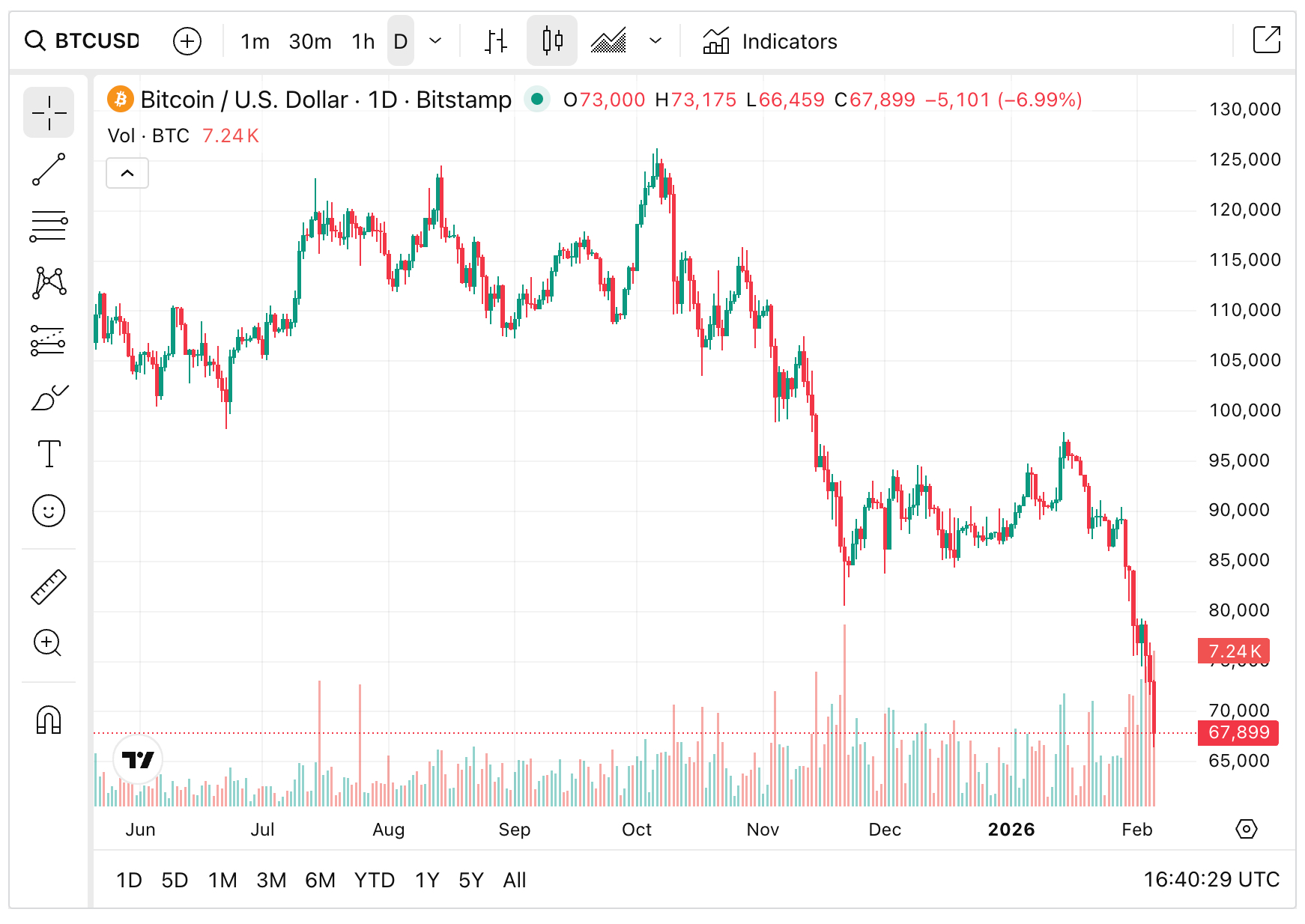
Bitcoin is down. Not just down a little...but grinding lower, testing key technical levels, and making even long-term bulls uncomfortable. As prices slipped toward the low $70,000s, the usual arguments erupted across financial media and crypto Twitter. Some called it a routine pullback. Others dismissed it as fear-mongering.
But one voice cut through the noise in a very different way.
Michael Burry...yes, that Michael Burry...raised the possibility of something far more serious: a Bitcoin death spiral.
Not because Bitcoin is “bad.” Not because the technology failed. And not because the long-term thesis suddenly changed.
But because of balance sheets.
And more specifically, because of liabilities.
Why the Price Action Matters...but Not for the Reason You Think
On the surface, Bitcoin’s recent price behavior looks technical. Repeated tests of the same support level. Weak bounces. Lower highs. Traders know this pattern well.
But technical weakness alone doesn’t create systemic risk. What creates systemic risk is forced selling.
And forced selling doesn’t come from fear...it comes from liability mismatches.
That’s the key insight buried inside Burry’s analysis and the point George emphasized.. Markets don’t implode because assets go down. They implode because falling asset prices collide with fixed obligations.
The Liability Side Everyone Ignores
Most retail investors analyze assets in isolation. You buy Bitcoin. You buy gold. You buy stocks. If prices go down, you can wait. There’s no margin call from your paycheck.
Corporations, banks, and financial institutions don’t have that luxury.
They operate with balance sheets. And on those balance sheets sit liabilities...real, contractual obligations that are almost always denominated in U.S. dollars.
This is not a preference. It’s a structural reality of the global monetary system.
Loans, deposits, dividends, interest payments, preferred-share payouts...nearly all of them must be settled in dollars, regardless of what sits on the asset side.
And that’s where the risk enters.
Long-Term Assets, Short-Term Liabilities
Bitcoiners are honest about one thing: Bitcoin is volatile. Cycles last years. Drawdowns of 50% or more are not unusual.
That volatility is tolerable...if you don’t have short-term obligations.
But corporations like MicroStrategy aren’t playing with idle capital. They’ve layered Bitcoin exposure on top of:
Debt obligations
Preferred-share dividends
Ongoing operating expenses
None of those liabilities operate on a 10-year horizon.
When you pair long-duration, volatile assets with short-duration, fixed liabilities, you create fragility.
Not theoretical fragility.
Mechanical fragility.
Why Banks Prefer Treasuries
This is precisely why banks overwhelmingly prefer U.S. Treasuries.
It’s not because Treasuries are exciting. It’s because they allow:
Currency matching (USD assets vs. USD liabilities)
Maturity matching (2-year assets vs. 2-year liabilities)
A bank with a two-year dollar liability can buy a two-year Treasury and lock in the spread. No FX risk. No duration mismatch. No volatility-induced solvency risk.
Bitcoin offers none of that.
The Mechanics of a Death Spiral
Burry’s concern is not ideological...it’s mechanical.
Here’s the chain reaction he outlines:
Bitcoin prices fall materially.
Corporate balance sheets deteriorate.
Risk managers demand action.
Assets with liquidity are sold to meet dollar obligations.
Bitcoin selling pushes prices lower.
Lower prices stress additional balance sheets.
The cycle repeats.
That’s not fear. That’s math.
Why Precious Metals Got Hit Too
This dynamic also explains why gold and silver often fall with Bitcoin during liquidity events.
If institutions face a dash for cash, they don’t sell what they hate...they sell what they can.
Gold has a bid.
Silver has a bid.
Bitcoin has a bid.
So they all get sold.
That doesn’t invalidate the long-term thesis for any of those assets. It simply reveals that dollars sit at the top of the hierarchy in a crisis.
The Dollar’s Hidden Power
Here’s the irony few people appreciate.
Almost every dollar in existence is the result of a loan. That loan creates both an asset and a dollar-denominated liability.
Which means that when stress hits, those liabilities create automatic demand for dollars.
This is why, in every global crisis, the dollar strengthens...not weakens.
Bitcoin doesn’t face this problem because it doesn’t have liabilities. But the institutions holding Bitcoin absolutely do.
MicroStrategy as the Case Study
Burry highlights MicroStrategy because it represents the most extreme version of this trade.
If Bitcoin falls meaningfully below current levels, the company could find itself:
Billions underwater on paper.
Locked out of capital markets.
Forced to service dollar liabilities without fresh funding.
At that point, even “non-recourse” narratives collapse. Dividends don’t pay themselves. Preferred-share structures that ratchet payouts higher during stress make matters worse...not better.
That’s when balance-sheet math overwhelms conviction.
This Is Bigger Than Bitcoin
The real lesson here isn’t about whether Bitcoin goes to zero or a million.
It’s about how every monetary system behaves under stress.
When assets fall and liabilities remain fixed:
Liquidity matters more than yield.
Cash beats conviction.
Mismatches get exposed.
This is exactly what happened to Silicon Valley Bank. Their assets were “safe.” Their liabilities were short-term. The mismatch killed them.
Bitcoin simply introduces volatility into the same equation.
Does This Mean Bitcoin Is Doomed?
No.
But it does mean that Bitcoin on corporate balance sheets is fundamentally different from Bitcoin held outright by individuals with no leverage.
Price volatility doesn’t kill assets.
Liabilities do.
The Overarching Takeaway
When analyzing any asset...Bitcoin, gold, stocks, or real estate...the starting point should not be the asset itself.
It should be the liabilities attached to it.
Retail investors can afford to ignore this.
Institutions cannot.
That single distinction explains nearly every financial crisis in history.
Balance Sheets Decide Everything
Bitcoin didn’t invent financial fragility.
It simply exposed it.
The death-spiral conversation isn’t about price targets or chart patterns. It’s about whether balance sheets can survive volatility when obligations are fixed in dollars.
That’s not a Bitcoin problem.
That’s a monetary system problem.
And understanding that difference is what separates investors from spectators.
Prepare accordingly.
Hey guys, I know I got a late reply. I hope someone reads it. I really enjoy your videos so much more than reading tiny letters on my phone. I don’t know, but a lot of people would love to listen to your instruction with voice inflection, etc. etc.
Not criticism, just asking if you could do it.
I always enjoy getting something in my inbox from you guys.
Shitcoin will go to its instinctive value. Zero