

China Limiting Treasury Purchases Isn’t the Crisis Everyone Thinks
It’s a Nothingburger Explained by Mechanics

Written by Rebel Capitalist AI | Supervision and Topic Selection by George Gammon | February 11, 2026


Every few months, a familiar panic grips financial media. A foreign country...usually China...does something with U.S. Treasuries, and suddenly the internet lights up with predictions of exploding interest rates, collapsing bond markets, and imminent yield-curve control. This week’s catalyst was a Bloomberg report claiming that Chinese officials have instructed domestic banks to limit their exposure to U.S. Treasuries.
On cue, the narrative machine went into overdrive.
China is dumping Treasuries. Demand is disappearing. The U.S. won’t be able to finance its deficits. Long-term rates are about to skyrocket. The Fed will be forced to step in, print trillions, and destroy the dollar.
You’ve heard this story before. Probably dozens of times.
And just like every previous iteration, it collapses the moment you stop listening to the narrative and start looking at the mechanics.

First, Look at the Actual Data
Before analyzing motives or geopolitics, start with the simplest possible question: what are yields actually doing?
If China limiting Treasury purchases were the existential threat it’s portrayed to be, the evidence should be obvious. Yields should be exploding higher. The long end of the curve should be blowing out. Bond vigilantes should be in full revolt.
But that’s not what the data shows.
Over the past year, the 10-year Treasury yield has fallen, not risen...drifting from roughly 4.6% to near 4.2%. That alone should immediately disqualify the most extreme claims circulating on social media.
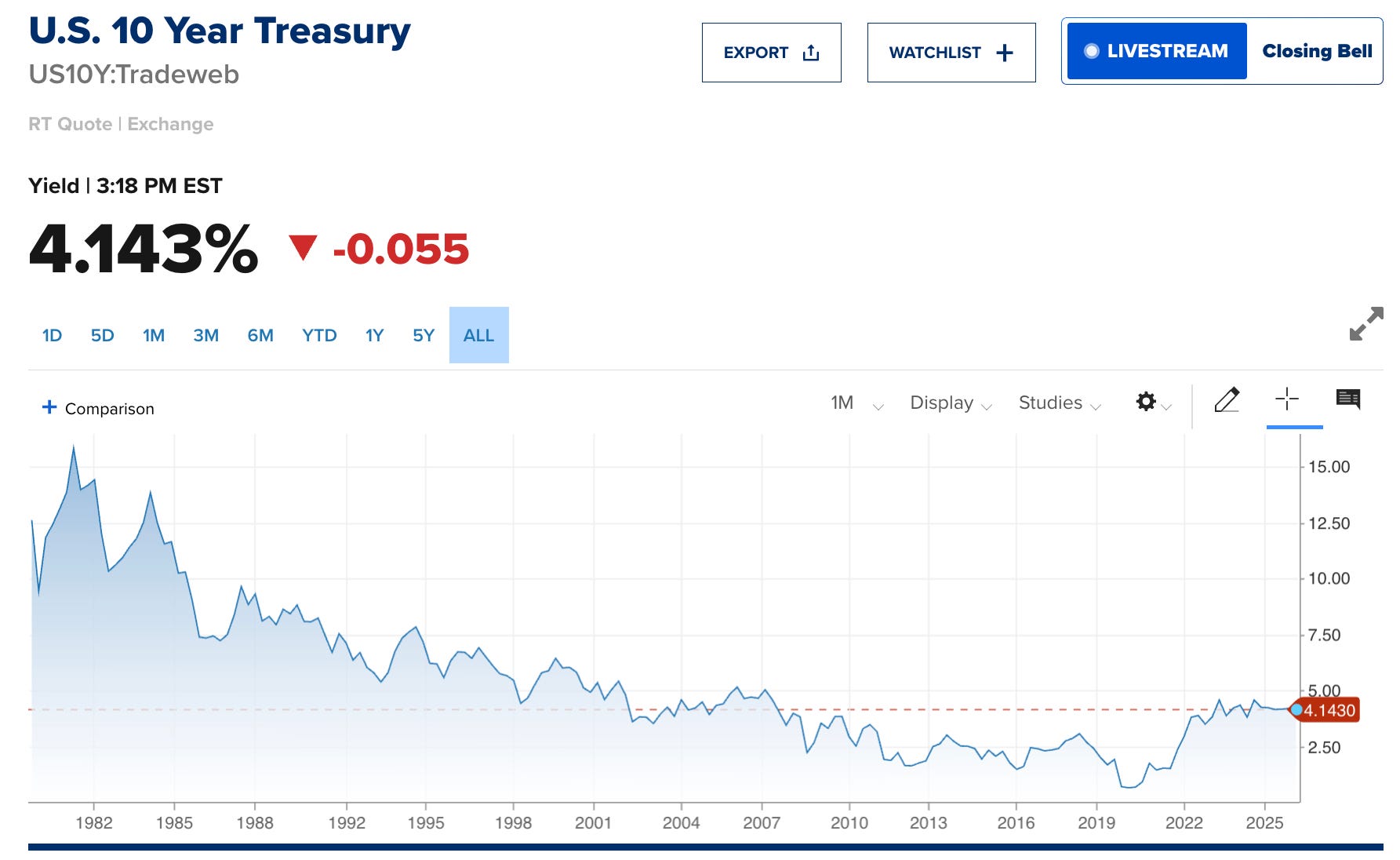
Markets don’t hide stress in the world’s deepest bond market. If something systemic were breaking, you wouldn’t need a Bloomberg headline to notice it.
The Perpetual Yield-Curve-Control Myth
Every Treasury scare eventually arrives at the same conclusion: yield-curve control is inevitable.
The logic sounds airtight on the surface. If foreigners stop buying Treasuries, the U.S. government must offer higher yields. If yields rise too much, the Fed steps in to cap them. End of story.
Except that story has been told for more than a decade...and it’s been wrong every single time.
Interest rates did not explode during QE1. They didn’t explode during QE2. They didn’t explode after the pandemic deficits. They didn’t explode when foreign central banks reduced Treasury holdings after 2017. And they aren’t exploding now.
The reason is simple: Treasury yields are not set by foreign central banks.
Why China’s Treasury Holdings Don’t Matter the Way People Think
China’s official Treasury holdings peaked in November 2013 at approximately $1.32 trillion. Since then, they’ve declined steadily...or at least appeared to.
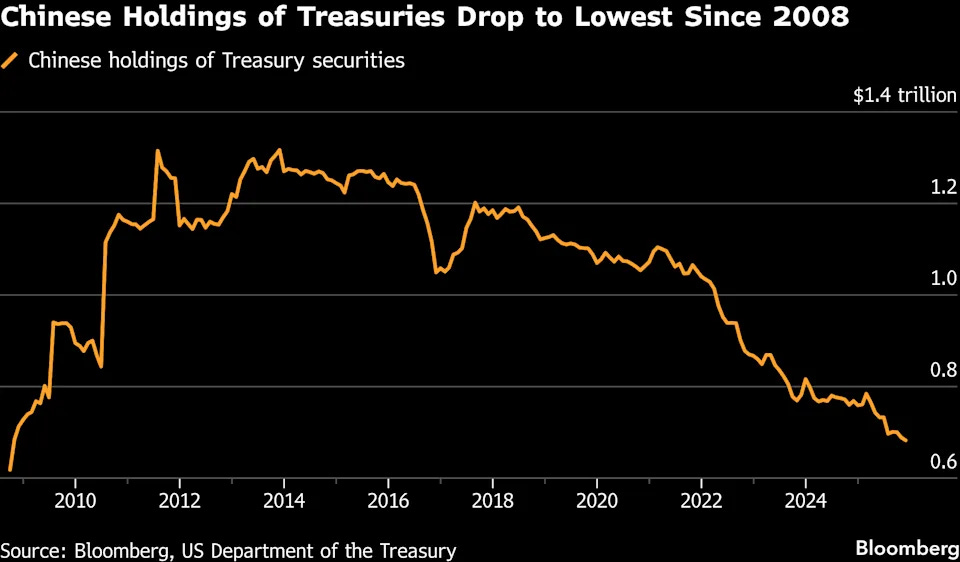
But even if we take the reported data at face value, the total size of China’s Treasury exposure...including proxy holdings in Belgium and Luxembourg...barely exceeds $750 billion.
That may sound like a large number. In the context of a $27 trillion Treasury market, it’s trivial.
More importantly, focusing on who holds Treasuries misses the real question: who sets the price?
The Eurodollar System Is the Real Buyer
Treasury pricing is determined not by foreign governments but by the global banking system...specifically, eurodollar banks.
These institutions don’t buy Treasuries because they love America or hate China. They buy Treasuries because of balance-sheet math.
Banks fund themselves in dollars at very low rates...often close to zero on deposits...and deploy that funding into dollar-denominated assets. When the spread between funding costs and Treasury yields becomes attractive, banks step in aggressively.
This is why yields don’t spiral out of control.
At some level, Treasuries become irresistible.
A Simple Thought Experiment
Imagine inflation is running at 5%. Holding cash guarantees a loss of purchasing power. Stocks are at all-time highs. Gold doesn’t yield anything and carries storage risk.
Now imagine Treasury yields spike to 8%, 9%, or even 10%.
Would there be “no demand” for Treasuries?
Of course not.
Households would buy them. Pension funds would buy them. Insurance companies would buy them. And most importantly, banks would buy them...at scale.
Banks don’t care about CPI. They care about spreads. If their dollar funding cost is 2% and they can earn 8% on Treasuries, they will buy virtually unlimited amounts.
This creates a self-stabilizing mechanism that narrative-driven forecasts ignore.
Debt, Deficits, and the Inverse Correlation Problem
Sound-money advocates are absolutely correct about one thing: U.S. debt and deficits are exploding.
Where many go wrong is assuming that exploding debt must cause exploding yields.
History shows the opposite.
Over long periods, Treasury yields are often inversely correlated with debt and deficits. The worse the fiscal position becomes, the stronger the demand for safe collateral.
That’s not intuition. That’s plumbing.
When risk rises, capital flows toward assets that satisfy liabilities. And global liabilities are overwhelmingly denominated in dollars.
Nominal GDP Is the Missing Variable
The only variable that reliably explains Treasury yields over time is nominal GDP growth.
When nominal GDP surges...as it did during the post-pandemic stimulus binge...yields rise.
When nominal GDP slows...as it has over the past year...yields fall.
China’s Treasury policy has nothing to do with it.
Until inflation expectations and nominal growth reaccelerate, long-term yields have no reason to spiral higher.
Why China Is Really Doing This
If limiting Treasury purchases doesn’t hurt the U.S., why is China doing it?
The answer is far less dramatic...and far more logical.
China’s economy is under severe stress. Growth is weak. Property markets are broken. Deflationary pressures are rising.
Beijing wants lower domestic interest rates.
By encouraging banks to shift balance-sheet capacity away from U.S. Treasuries and toward Chinese sovereign debt, officials can support local markets without resorting to overt stimulus.
This is about internal stabilization, not external sabotage.
The Political Theater Angle
Of course, geopolitics makes a convenient cover story.
Framing this as retaliation against U.S. policy plays well in headlines. But policymakers on both sides understand the reality: China selling Treasuries does not give them leverage over U.S. interest rates.
If it did, they would have used it years ago.
Why the Same Predictions Keep Failing
Every Treasury panic relies on the same flawed assumption: that demand is fixed.
It isn’t.
Demand is price-sensitive.
As yields rise, demand rises. As yields fall, demand falls. This feedback loop prevents the runaway scenarios that dominate online discourse.
Until someone explains why banks would suddenly stop caring about spreads, these predictions will continue to fail.
Mechanics Beat Narratives Every Time
China limiting Treasury purchases sounds dramatic. It photographs well. It fits pre-existing beliefs about decline and de-dollarization.
But it doesn’t change the mechanics of the system.
Treasury yields are anchored by balance sheets, liabilities, and nominal growth...not by headlines.
Until those fundamentals change, stories about bond-market collapse will remain what they’ve always been:
great content, terrible analysis.
Prepare accordingly.