

Is MicroStrategy In Trouble?
When Leverage, Narrative, and Reality Finally Collide...

Rebel Capitalist AI | Supervision and Topic Selection by George Gammon | December 2, 2025


Bitcoin is down big. MicroStrategy is down even bigger. And for the first time since Michael Saylor turned a sleepy software company into a leveraged Bitcoin proxy, the market is asking a very uncomfortable question:
Is MicroStrategy actually in trouble?
Not bankrupt tomorrow. Not a 2024-style Twitter panic. But structurally, fundamentally, financially in trouble.
After digging through the latest numbers, the debt structure, the convertible notes, the preferred dividend obligations, and the new USD reserve Saylor just created, the answer becomes clear:
MicroStrategy isn’t going bust next year...but the business model is finally running into the brick wall everyone warned about.
And that brick wall has implications not just for MSTR stock, but for the price of Bitcoin itself.
Let’s break it down.
The Stock Isn’t Crashing...It’s Unwinding
MicroStrategy didn’t just have a bad day. The stock is down nearly 50% year-to-date and has been bleeding for months. Investors can talk about “volatility” and “long-term conviction” all they want, but eventually even true believers get exhausted.
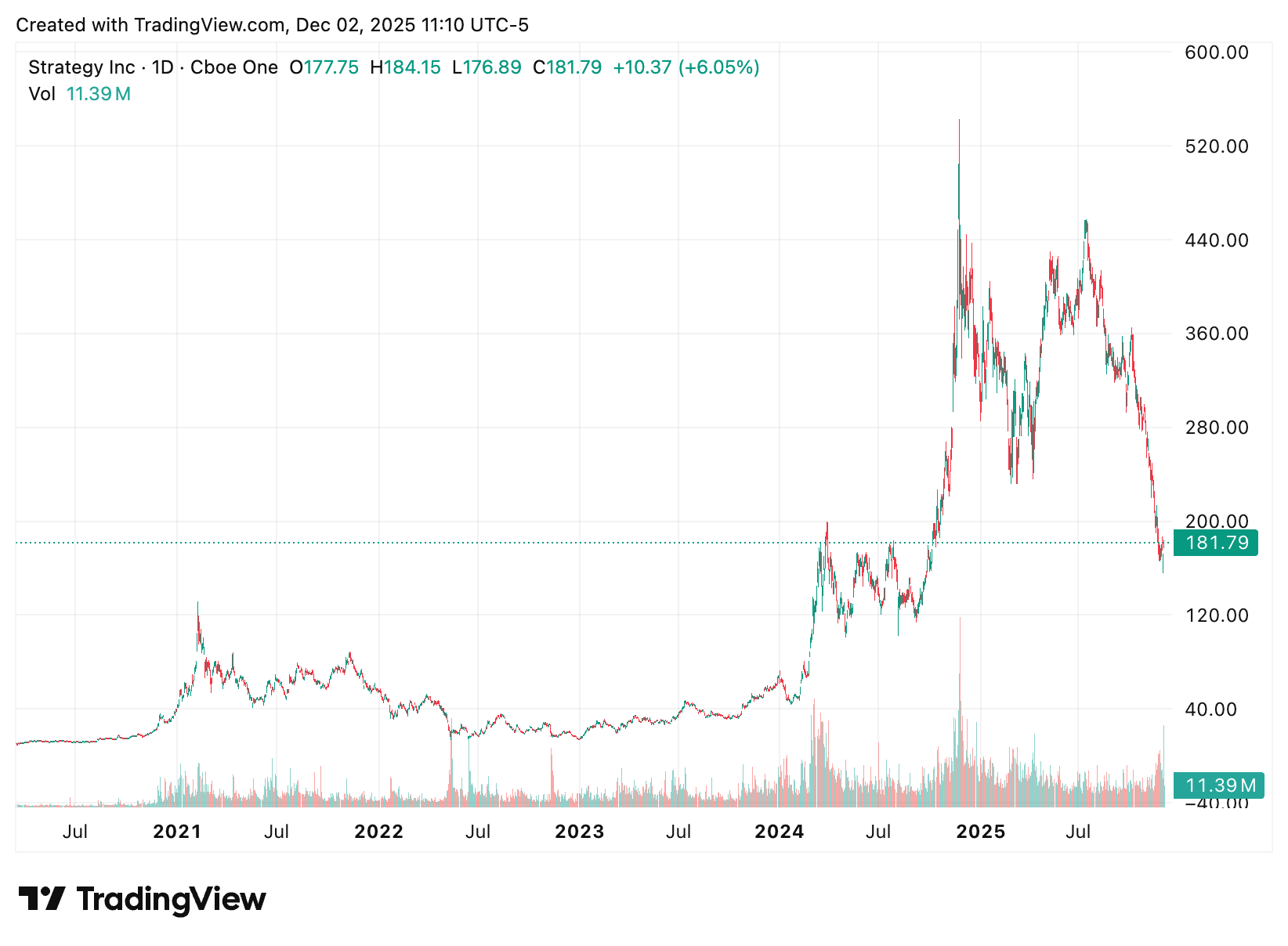
A chart tells the truth. The recent downtrend isn’t chop. It’s a one-way elevator down.
At some point, even diamond-handed Bitcoiners who “get the mission” start asking: Why am I losing money faster owning this than I would just holding Bitcoin?
And that’s where the real pressure begins.
But that pressure doesn’t build in isolation...because the next piece of the puzzle shows why this unwind wasn’t just predictable, but mathematically certain.
The Leverage Problem Everyone Ignores
Let’s get clear about the structure:
MicroStrategy holds roughly 650,000 BTC.
It has over $8.2 billion in debt.
It has ongoing interest obligations.
It now has large preferred dividend obligations.
If Bitcoin dropped into the low teens...$12,000 or so...MicroStrategy’s liabilities could exceed its assets.
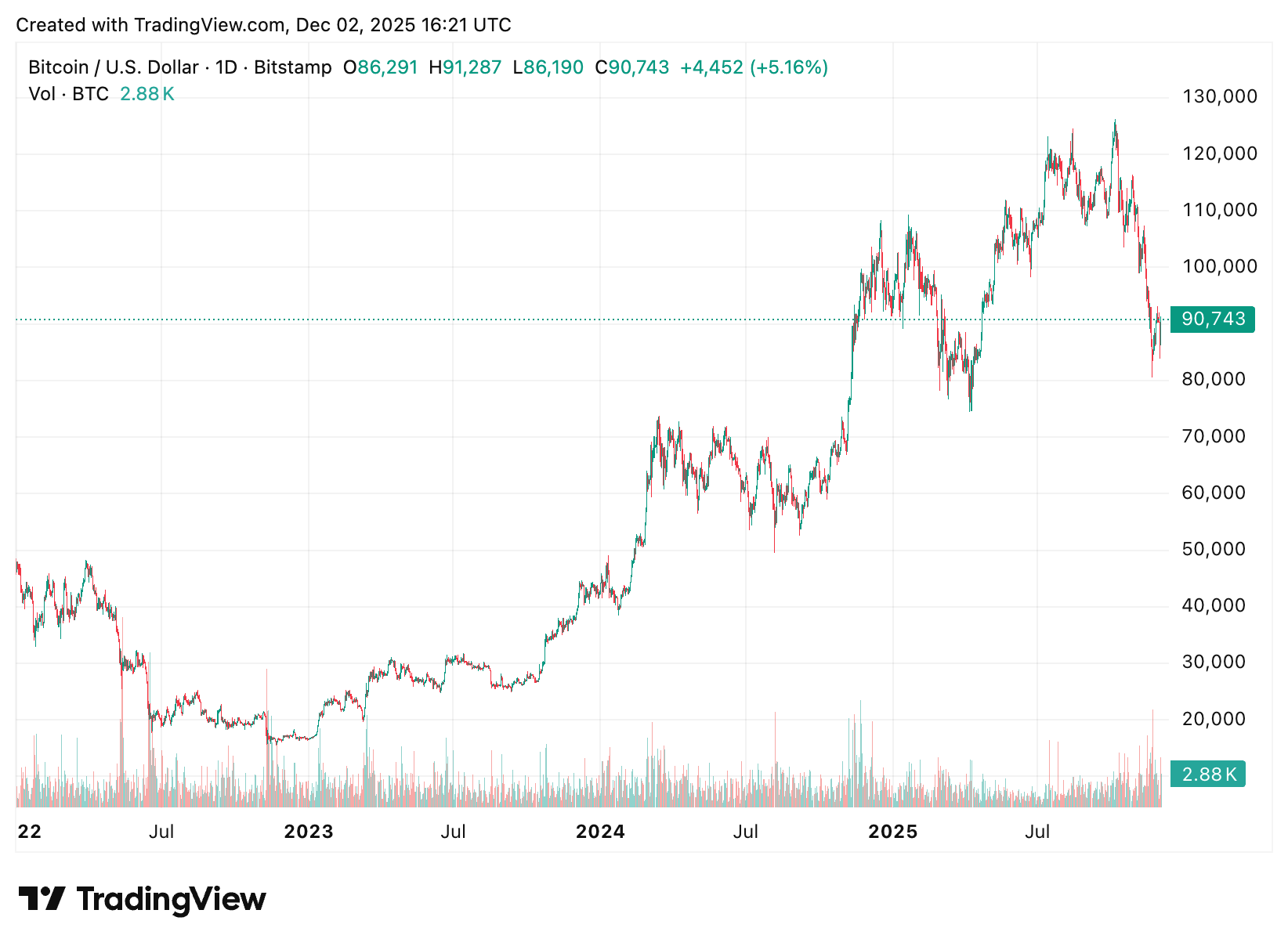
Not bankrupt-on-Monday morning. But negative equity...which has major consequences for confidence, creditworthiness, and the stock price.
And while Saylor’s disciples don’t want to admit this, he is locked into a very rigid math problem:
Everything he owes is in dollars. Everything he owns is Bitcoin.
That mismatch is the same mismatch that forces emerging markets to defend their currency with USD reserves. It’s the same mismatch that triggered sovereign debt crises for decades.
It’s also why Saylor quietly just created something no one expected:
A USD reserve. And the moment you understand why that reserve exists… the next domino suddenly becomes impossible to ignore.
Yes, the “Bitcoin Forever” Company Just Created a Fiat Reserve
The entire ideological pitch behind MicroStrategy was:
Convert all excess cash into Bitcoin.
Hold forever.
Never sell.
So why...suddenly...does the company need a $1.44 billion U.S. dollar reserve?
Because the market is calling Saylor’s bluff.
Investors who bought the preferreds and convertibles at 10% yields are starting to realize something simple:
If Saylor can’t attract new buyers for his perpetual Bitcoin-backed fundraising machine, he has to start selling assets to pay them.
And selling Bitcoin defeats the entire narrative.
Thus the reserve. It buys time. It buys confidence. It buys stability.
It also confirms the one thing Saylor never wanted to admit:
MicroStrategy can’t operate without dollars.
And once you see the need for dollars, the next problem becomes obvious...the exact place where every leveraged empire eventually begins to fracture.
The Convertible Debt Is a Disaster
If you want to understand why MicroStrategy is wobbling, look at the convertible notes.
Investors bought billions of dollars’ worth of these notes with conversion strike prices like:
$672/share
$425/share
And only one tranche anywhere near the current stock price.
These investors were betting MSTR would soar so high that converting debt into equity would be a no-brainer.
Instead, almost every tranche is underwater.
Which means:
Those investors will not convert.
They will demand repayment.
And MicroStrategy will have to find the cash somewhere.
When Saylor tries to issue new notes, he faces a wall. Why would anyone lend him money at today’s prices when the last six groups got smoked?
This is where he is boxed in. The more he tries to raise, the worse the terms become. The higher the dividend he must promise. The worse the dilution for common shareholders.
It’s the same dynamic doomers have forecast for the U.S. Treasury: debt issuance begets more issuance at worse yields.
MicroStrategy is tasting its own version. And unfortunately for Bitcoin holders, the next layer of this spiral directly touches the asset they’re convinced is immune.
Bitcoin Falling Makes Everything Worse
In the short term, the key question isn’t whether MicroStrategy survives.
It’s this:
What happens to Bitcoin when the “Saylor Bid” disappears?
For years, every dip was met with “MicroStrategy buys another $400M in BTC.”
That constant bid mattered. It created confidence. It created a floor. It created a narrative.
But if Saylor can’t raise capital...because markets won’t fund him at cheap terms anymore...that bid vanishes.
We may be witnessing the first market reaction to that reality. Bitcoin didn’t just fall...it dropped fast. That’s what happens when a key buyer gets sidelined.
If MicroStrategy ever had to sell Bitcoin? The market hasn’t priced that in at all.
And ironically, the very thing Saylor said Bitcoin would destroy...the power of the dollar...is the one force now keeping his entire empire afloat.
Saylor’s Irony: Proving the Dollar’s Power
The final twist in all of this is the most interesting.
Saylor has spent four years arguing Bitcoin would replace the dollar.
But now he’s demonstrating why the dollar remains the most powerful monetary network on Earth.
Why do emerging markets need USD reserves?
Why does Japan defend against yen depreciation?
Why does India defend the rupee?
Why do corporations around the world settle in dollars?
Because in stress scenarios...real-world stress...everyone wants dollars.
MicroStrategy is now no different.
He can’t pay his preferred dividends in Bitcoin.
He can’t settle his liabilities in Bitcoin.
He can’t reassure nervous investors with Bitcoin.
So he did what every other entity caught in a dollar short squeeze does: build a dollar reserve.
Not because he wanted to.
Because he had to.
And that leaves one final question...the one Wall Street is whispering about, but Bitcoin Twitter refuses to touch.
So Will MicroStrategy Go Bust?
Not in the next two years. The maturities are far out. The debt runway is long. And Bitcoin would have to collapse into the low teens to flip them negative on equity.
But that doesn’t mean everything is fine.
MicroStrategy is no longer in its aggressive growth phase. It is now in its defensive liquidity phase.
That changes everything:
No easy access to cheap debt.
No reliable ability to raise new funds.
No clean path to keep accumulating Bitcoin.
Rising dividend obligations.
A shareholder base that is finally showing fatigue.
The model depended on endless leverage at lower and lower yields.
That era is over.
MicroStrategy is not going to zero. But the days of “infinite Bitcoin accumulation through financial engineering” have ended.
And the Bitcoin market needs to adjust to that.
Which brings us to the real heart of this story...the collision between narrative and arithmetic that every investor eventually faces.
When Narrative Meets Math
This entire saga proves one thing:
Narratives are powerful…until math shows up.
Saylor built the strongest narrative in Bitcoin history:
Bitcoin as a treasury reserve.
Leverage as a weapon.
Balance sheet as a Bitcoin ETF.
“Never sell” as a religion.
But now he is confronting the sober reality every highly-leveraged operator eventually faces:
Debt doesn’t care about your mission.
Credit markets don’t care about your passion.
Dividend obligations don’t care about your ideology.
MicroStrategy is not collapsing.
But it is cornered.
The next chapter won’t be about how much Bitcoin it buys.
It will be about whether it can survive long enough not to be forced to sell.
That question matters not just for MSTR shareholders...but for everyone holding Bitcoin.
Prepare accordingly.
Before You Go...A Message to Rebel Capitalists
If you’re reading this, you already know the mainstream financial media won’t touch stories like this until it’s too late.
Here, we go where the incentives hide…
Where the leverage hides…
Where the real risks hide.
That’s what Rebel Capitalists care about...protecting their freedom, their purchasing power, and their portfolios from a system built on bad incentives and worse narratives.
If you want deeper breakdowns, early warnings, and unfiltered macro analysis every week…
If you want to stay ahead of the herd instead of crushed beneath it…
👉 Upgrade to the Rebel Capitalist News Desk
https://rebelcapitalist.com/subscribe

Because the next phase of this cycle won’t reward the informed.
It will punish the uninformed.
And we refuse to let our readers be the latter.
I used to think like the author of this article. I no longer do because I've studied what Saylor is trying to do and, yes, its bold and daring, but his playbook isn't new and it has worked in the past. He is essentially trying to recreate what the bank of England did centuries ago. Will it work? Only time will tell. I can imagine at least 20 financial products on top of the ones he launched this year. If he can become the JPM of bitcoin, then he will be 10x berkshire hathaway easily. If you are not confident in bitcoin's future or MSTR's leadership, then these conclusions are definitely the bear case. I'm bullish on this company over the next 5-10 years and I'm allocating a small allocation for massive upside potential. This is definitely the async trade we all wait on. Imagine owning a piece of the bank of England or the Federal Reserve?
I wish you well. What is the bull case for bitcoin? Only 1 million more bitcoin will be created ever. Bitcoin is heavily reliant on liquidity. Bitcoin is now competing for electricity with AI data centers. AI data centers are raising the cost of electricity, which hurts Bitcoin.
Bitcoin YTD: -0.64%
Gold: +60.35%
Silver: +102.26%
VanEck Junior Gold miners: +150.97%
Amplify Silver Junior miners: +162.24%
If Bitcoin can’t beat a reserve asset like gold, with the most crypto friendly president ever, what good is it?