

Not A Deal
Markets just ripped on a piece of paper. Almost nobody read what it actually says.


![[Section Divider Image]](https://substackcdn.com/image/fetch/$s_!oS8H!,f_auto,q_auto:good,fl_progressive:steep/https%3A%2F%2Fsubstack-post-media.s3.amazonaws.com%2Fpublic%2Fimages%2Fe69bc1b8-0a09-4106-9f01-8e8ee0681e5c_1320x50.webp "[Section Divider Image]")
There is no Iran peace deal.
Read that again, because every headline this week wants you to believe the opposite. What actually got signed is a 60-day memorandum of understanding to extend a ceasefire. Not a peace deal. A memorandum. An agreement that the two sides agree they cannot yet agree on anything, dressed up in a tuxedo and walked down the red carpet as the greatest diplomatic achievement of the century.
And markets bought it. Oil sold off hard, crashing as much as 20% on the ceasefire news from levels that had spent most of the spring north of $100. Stocks surged. Bond yields slipped. Crypto ripped. The entire risk complex repriced on a piece of paper that still needed sign-off and remained unfinalized at the moment of the repricing.
Here is the thing nobody on the financial desks wants to say out loud: none of that price action had anything to do with reality. It had to do with the story. And once you accept that the story is the only thing that moves markets anymore, a much more uncomfortable question shows up at your door.
If the market doesn’t price reality, how on earth are you supposed to position a portfolio against it?
The market stopped pricing reality a long time ago
Start with the deal itself, because it is the cleanest example of narrative beating fact you will see all year.
A memorandum of understanding is what you produce when you cannot produce a deal. Both sides sit down, conclude there is no agreement to be had, and then need to walk out with something to hand the voters back home. So they manufacture a document that says, in effect, we agree to keep talking. The Strait of Hormuz reopens, the transit fee gets a 60-day pause, and the nuclear question, the actual reason this started, gets shoved into “future negotiations.” Three months of destroyed infrastructure and dead young men, and the logistics land roughly back where they started. On net, that is a negative. Yet it gets written into history as a win.
Picture an arsonist who torches the top floor of a two-story house, waits three months, comes back, puts out the fire on that one floor, and then calls a press conference to celebrate his heroism. That is the deal. That is the whole deal.
The principal Middle East analyst at risk consultancy Verisk Maplecroft cut through it cleanly, warning that pushing the hardest issues into later talks prolongs the uncertainty and leaves the underlying confrontation unresolved. That is the honest read, and it lines up with what the physical market kept signaling even as the headlines celebrated. It is also the read that got zero airtime, because honesty doesn’t move a tape and a red-carpet signing in Geneva does.
So if you are still trying to trade the reality, you are playing a game that ended years ago. The market isn’t lying to you. The market simply stopped caring whether the story is true.
Exhibit A is worth two trillion dollars
You want proof that narrative is the only currency that matters? Look at the largest IPO in the history of the planet, which just priced.
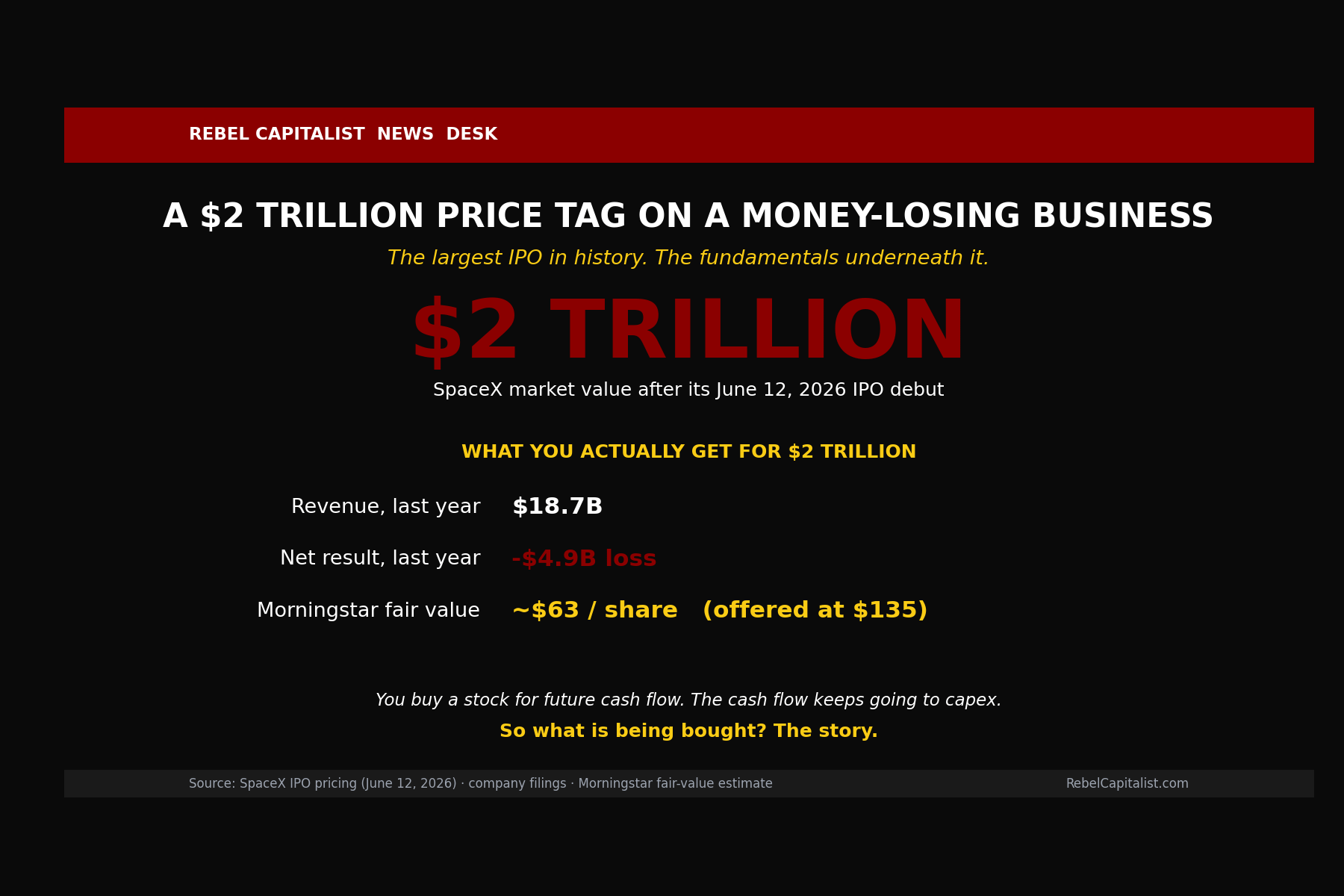
SpaceX went public on June 12, selling 555.5 million shares at $135 each to raise roughly $75 billion, with early trading pushing the valuation past $2 trillion. Largest offering ever, more than double the Saudi Aramco record.
Now look at the business underneath the valuation. Revenue last year ran around $18.7 billion against a $4.9 billion loss, with growth slowing from 35% to 33%. A two-trillion-dollar price tag on a company that lost five billion dollars and is decelerating. You buy a stock for future cash flow. But when the future cash flow gets incinerated by capital expenditure year after year, what exactly are you buying?
You are buying the story. And the story is spectacular. The story is that whatever is hot down here on Earth will be ten times better in space, so the plan is to take the hottest thing in the world right now, AI compute, and build the data centers in orbit. Orbital data centers. No cooling problems, infinite solar energy, a constellation of up to a million satellites doing the math somewhere above your head.
Does it matter that putting a data center in orbit costs a fortune more than building one in Nevada? Does it matter that Morningstar ran the numbers and pegged fair value at around $63 a share against the $135 offering price, meaning buyers are paying roughly seventy bucks a share in pure option premium on engineering problems nobody has solved? It does not. The narrative ate the arithmetic for breakfast and asked for seconds.
That is the world. Not the world anyone wants. The world everyone has.
So where is all this money coming from?
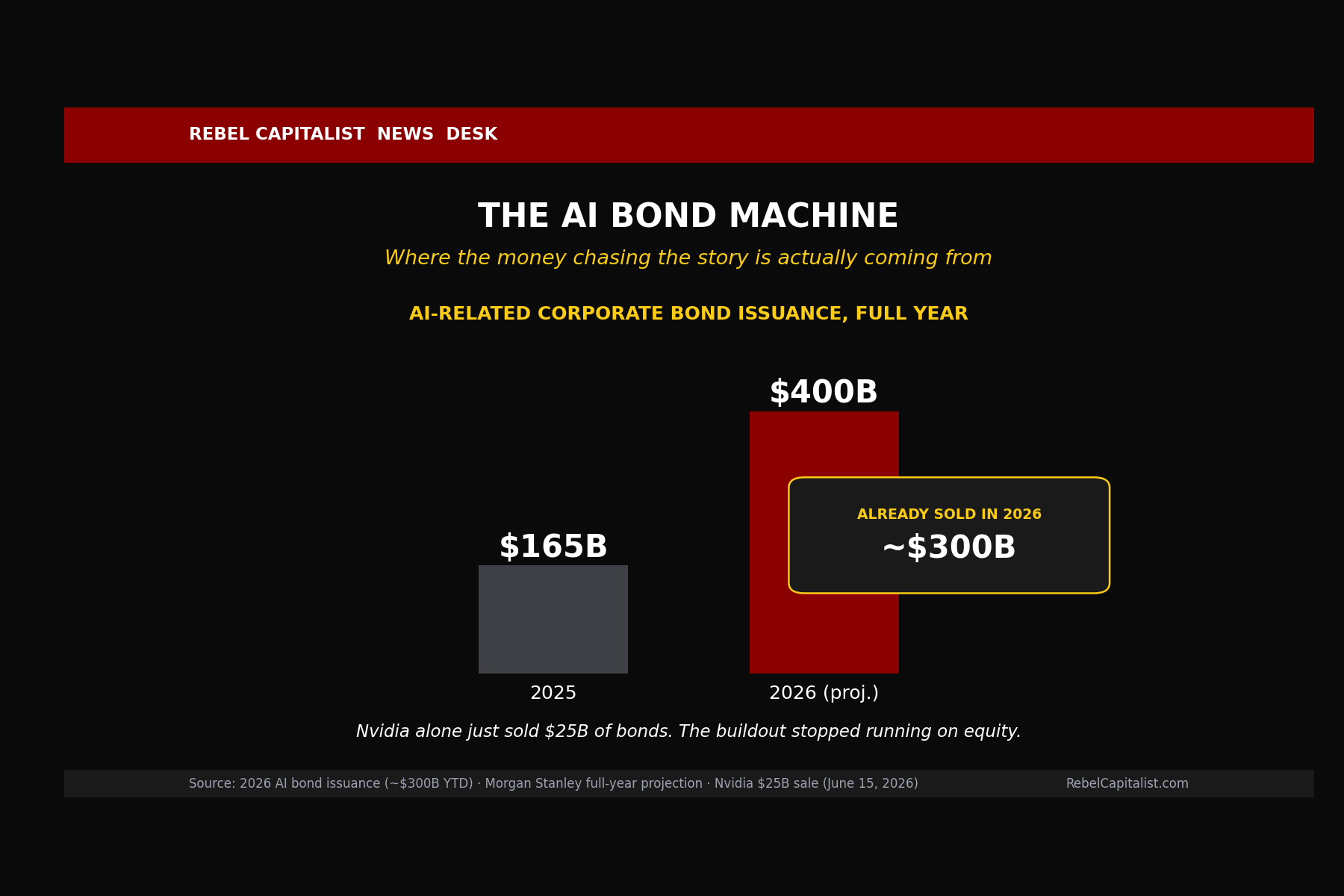
Here is where it gets interesting, because the story requires fuel, and the fuel is capital. Billions into SpaceX. Billions into the AI buildout. Nvidia just walked into the bond market and walked out with $25 billion in its largest debt deal ever, drawing $85 billion in orders to fund chips and data centers. AI-related borrowers have now sold roughly $300 billion in bonds in 2026 alone, with Morgan Stanley projecting hyperscalers issue a collective $400 billion this year. The hyperscaler buildout that used to run on equity has quietly turned into a structured-finance story.
So the honest question is the only one worth asking right now. Where is all this money coming from, and is it infinite?
The reflex answer is money printing. Pull up M2 money supply on a standard chart and the line goes nearly vertical. Your favorite gold bug loses his mind. Look at the printing, he says. There’s your answer, right there.
Except that chart is nominal, and nominal growth tells you almost nothing. What matters is the percentage rate of growth. A trillion-dollar increase is a catastrophe if it represents a 100% jump and a rounding error if it represents 1%. Switch M2 to a log scale and the picture inverts. The trajectory of percentage growth from the 1960s into the 1980s was far steeper than anything in the last decade. Even the COVID spike, when M2 jumped roughly 25% in a year, washes out across the full five-year window. M2 compounded at about 6.5% a year from late 2020 through late 2025, a pace that is unremarkable next to the 1980s and quieter than several five-year stretches in the historical record.
That reframes everything. The percentage growth of the money supply is historically subdued, not extreme. Which means the trillions chasing orbital data centers are not pouring out of some fresh monetary fire hose.
The trade nobody on the desk is talking about
If the money isn’t being conjured from thin air at any unusual rate, then on net it is being lent into existence by banks, or simply moved. Robbed from Peter to pay Paul. Capital pulled out of the real economy and shoved into the financial one. M2 is a derivative of bank lending, not the Fed’s balance sheet, and there is no evidence that small and mid-sized businesses are seeing a flood of new credit. The money creation that is happening is funding financial assets and the AI complex. Main Street is getting the bill, not the loan.
And that is the setup that matters, because there is a credit cycle running underneath all of this while everyone stares at the Geneva guest list. Every few weeks another Blackstone or BlackRock vehicle quietly caps how much investors can pull, with Blackstone’s flagship private credit fund running tender offers limited to a fixed slice of shares quarter after quarter, and nobody connects it to anything. You can ignore the credit cycle for as long as you want. The credit cycle is not going to ignore you.
So how do you actually position against a market that prices fiction? Not by shorting it outright. Shorting the S&P 500 into a mania is a fast way to get carried out, because there is no telling when the insanity ends, and passive flows keep a structural bid under the whole thing no matter how absurd it gets.
The answer is a pairs trade. Go long the bubble and short something you like even less, then pocket the spread between them. The long leg neutralizes the directional risk of being short a melting-up index. The short leg is where the conviction lives.
Housing is the obvious short candidate. Higher rates crush the homebuilders. Lower rates would only show up because the economy is deteriorating, which is hardly bullish for the people who build and sell new homes. Damned either way, and not a dollar of the AI capital is flowing their direction unless a builder suddenly pivots to constructing data centers in low Earth orbit. Long the S&P 500, short a name like Lennar, and the delta between an index grinding higher and a builder grinding lower is the return. Same logic as long Bitcoin against short MicroStrategy: you are not betting on direction, you are harvesting the gap.
The discipline is in the entry. You do not initiate the short leg after it has already collapsed relative to your long. You wait for one of those green days where the thing you want to short rips harder than the index, the kind of day a fake peace deal manufactures, and you fade the bounce on the bet that it mean-reverts. None of this is investment advice, and if you run it carelessly you will lose money. But it is a way to play the game as it is actually being dealt, instead of yelling at clouds about the bubble while the bubble compounds.
What to watch from here
The flyer in all of this is private credit. It is the one variable getting swept under the rug precisely because it is the one that bites. A credit cycle turning while money-supply growth is historically low is not a comforting combination. It is the kind of quiet setup that looks like nothing right up until it looks like 2008.
Watch whether the Strait of Hormuz reopening actually restores supply, because shut-in wells do not come back like a light switch and every importer that burned through reserves now has to replenish them. Watch the yen, which sat pinned near 160 to the dollar even after the Bank of Japan hiked to 1%, a dollar wrecking ball that a real peace deal would have eased and didn’t. And watch whether the AI bond machine keeps clearing $300 billion in issuance without a hiccup, because the day that spigot coughs is the day the narrative finally has to meet the arithmetic.
There are no certainties here, only probabilities. The probability that says the most is this one: the market will keep chasing the next story long after the last one stops making sense, and the only edge available is to stop pretending the story has to be true to be tradable.
Facts > Narrative. Always.
Stand up for freedom, liberty, and free market capitalism. And don’t forget to hit subscribe if you are not already a subscriber.