

Nvidia's $250B OpenAI Backstop and the Credit Market Tell
Two markets read the same Nvidia headline on the same day...one shrugged, one flashed its biggest warning on record, and the answer sits in a public filing.

![[Section Divider Image]](https://substackcdn.com/image/fetch/$s_!Dnoi!,f_auto,q_auto:good,fl_progressive:steep/https%3A%2F%2Fsubstack-post-media.s3.amazonaws.com%2Fpublic%2Fimages%2F334084cf-9599-4d59-bce6-530abd8fe527_1320x50.webp "[Section Divider Image]")
Monday’s tape said nothing happened.
The Dow closed up 262 points, about half a percent, at 52,210. The S&P 500 finished up a point and change, call it flat. The Nasdaq slipped a fifth of a percent. Brent settled 6.3% lower at $85.87 after the United States and Iran paused their strikes, with West Texas Intermediate down harder still, more than 8% at its worst. Glance at the closes, go back to your day, and you would conclude the market chewed on the weekend’s news and decided it was fine.
The weekend’s news was that Nvidia is in talks to guarantee roughly $250 billion of financing so that OpenAI can lease a data center campus in southern Ohio.
One floor away, on a desk most equity investors never bother to look at, the reaction was not fine at all. Five-year credit default swaps on Nvidia’s debt, which are nothing more exotic than insurance contracts against Nvidia failing to pay, posted their biggest one-day jump on record, widening about 14 basis points to roughly 82 at the intraday peak. That contract only began actively trading last November. It has never moved like that before.
Two markets looked at the same headline on the same day. One shrugged. One repriced the risk of the most profitable company on earth. Somebody is reading this wrong, and the tell for which one is sitting in a public filing that takes about ninety seconds to find.
A note for free readers. This one is on the house, in full, no gate. The paid edition is where the weekly rates and positioning work lives, plus the levels being watched into each print. If this is the kind of read you want two or three times a week, consider joining us on the paid tier.
What Nvidia’s $250 Billion OpenAI Backstop Actually Does
Start with the strongest version of the bull case, because it is genuinely strong and it deserves a fair hearing before anyone takes a swing at it.
Vendor financing is not a scam. It is one of the oldest moves in industrial capitalism. When you make a capital good, and your customer needs a decade of financing to buy it, and the banks do not know your customer as well as you do, you put your balance sheet behind the deal. Every railcar builder, every aircraft manufacturer, every equipment maker in history has done some version of it.
And Nvidia has the balance sheet. Revenue of $81.6 billion in a single quarter. Net income of $58.3 billion in that same quarter. Cash, marketable debt, and marketable equity securities north of $80 billion. The demand for compute is real, it is unmet, and the buyers are lining up.
Look at the structure and it gets more reasonable, not less. Nvidia is not writing a check. It is guaranteeing a lease. The guarantee is contingent, it only bites if the tenant defaults, and it shrinks over time as the tenant makes its payments. SB Energy, the SoftBank power subsidiary developing the 10 gigawatt site on a decommissioned uranium enrichment plant about fifty miles south of Columbus, gets to borrow against Nvidia’s credit instead of its tenant’s. OpenAI has no investment grade rating, so without a backer, the debt either does not get raised or gets raised at a price that kills the project. Japan is putting $33 billion into the gas generation. The Commerce Department controls the power allocation. This is not two guys in a garage.
So the steelman goes: strongest balance sheet in the world underwrites a lease for a customer it knows better than any lender could, unlocks a project the country’s own energy department is sponsoring, and takes warrants for the trouble.
Fine. Now walk the mechanics.
The Number Buried in Nvidia’s Own 10-Q
Nvidia already does this. It has a guarantee book, it discloses it, and the disclosure is one paragraph long.
Go to the quarterly report filed with the SEC for the three months ended April 26, 2026, and find the facility lease guarantee note. Maximum gross exposure across every such agreement Nvidia has signed: $3.5 billion. Terms running five to seven years. Partners have parked $712 million in escrow to cut the exposure further. The company classifies them as credit derivatives and tells shareholders the guarantees were “not material.”
$3.5 billion.
The reported Ohio backstop is $250 billion. That is roughly seventy-one times everything Nvidia has guaranteed to date, combined. It is more than Nvidia’s entire revenue for fiscal 2026. It is several times its cash and marketable securities. And it sits alongside a separate conversation, reported at the same time, about financing up to $350 billion of chip purchases.
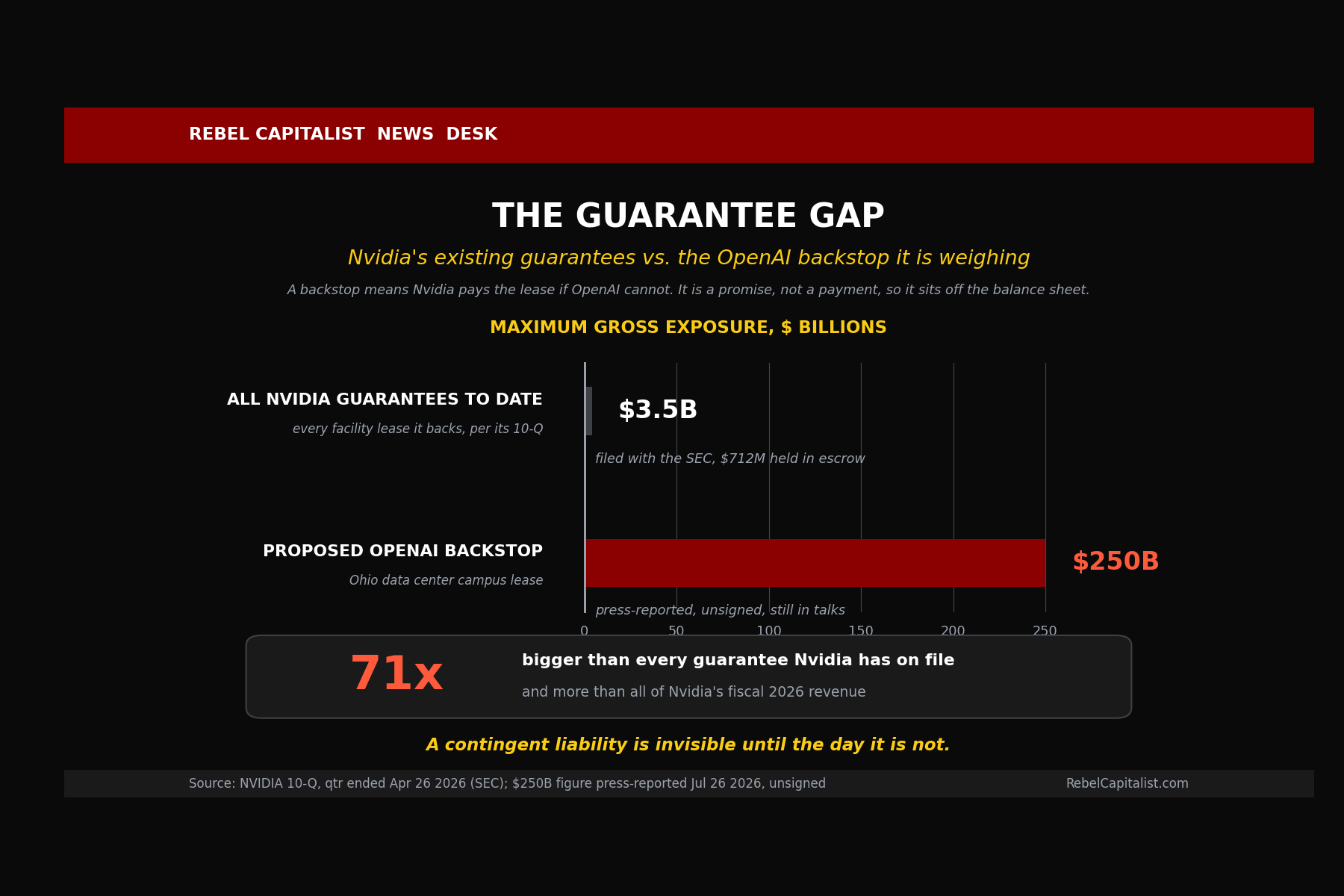
Is a jump in scale automatically a problem? No. Companies grow into bigger commitments all the time. But scaling a business line and scaling a contingent liability by seventy-one times in one negotiation are different animals, and the second one does not show up on the balance sheet until the day it does.
Where Nvidia’s Profit Came From Last Quarter
Here is the part nobody put in a headline.
In that same filing, Nvidia reported income before tax of $69.9 billion. Operating income was $53.5 billion. The gap, $16.4 billion of it, came in under total other income. Almost all of that was gains on equity securities. Marks on Nvidia’s investment portfolio.
What is in the portfolio? Non marketable securities, the line holding Nvidia’s stakes in privately held companies plus its infrastructure fund positions, went from $22.3 billion in late January to $43.4 billion by late April. Nvidia bought $18.6 billion of them in three months. The year ago quarter, that line was $649 million. Investment commitments outstanding: $27 billion.
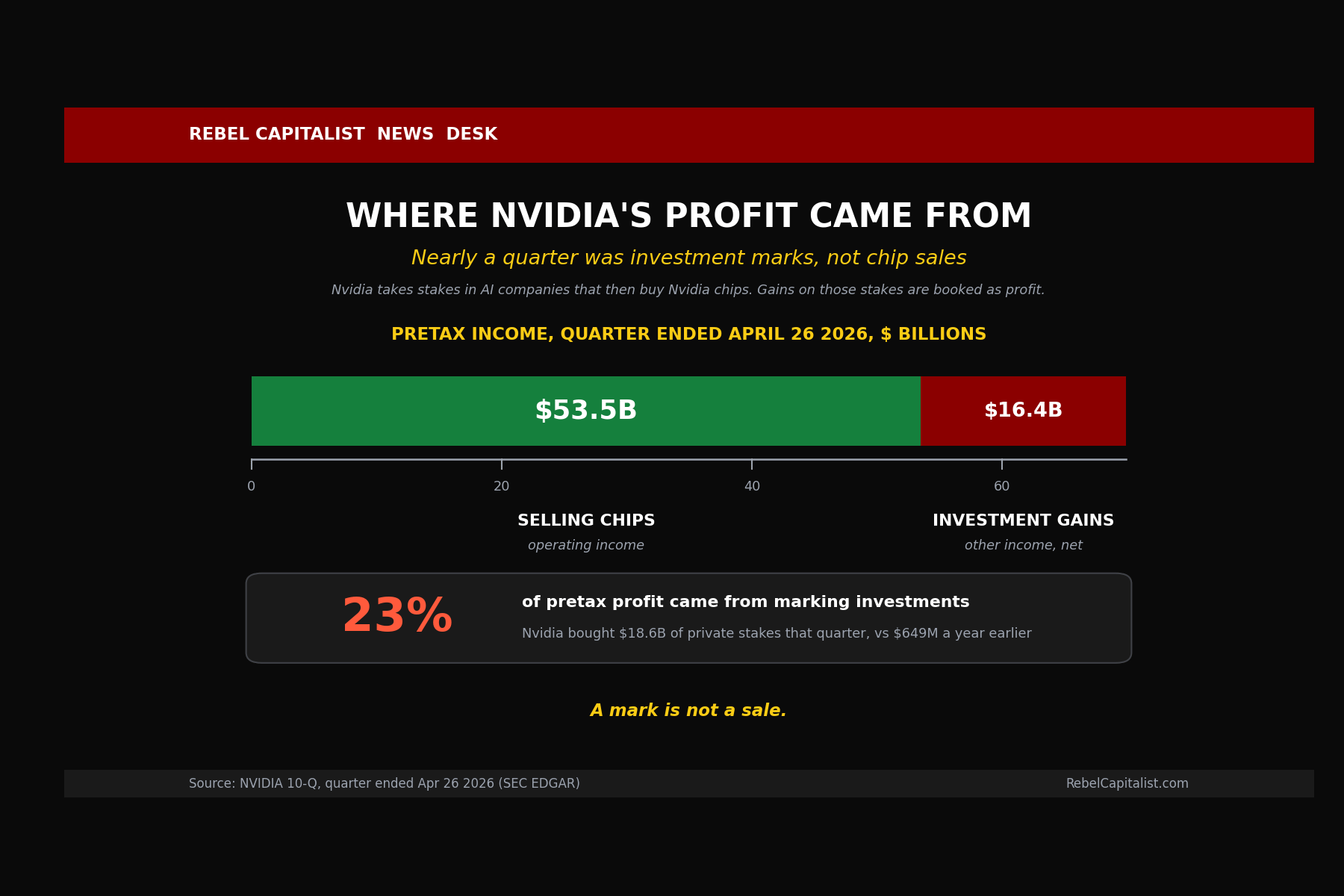
So roughly a quarter of the pretax income came from marking up positions in a private AI complex that Nvidia is simultaneously funding, supplying, and now proposing to cosign for. And on the revenue side, the same filing shows three direct customers accounting for 30%, 18%, and 16% of accounts receivable. Sixty four percent of what Nvidia is owed sits with three counterparties. One quarter earlier that number was 56%. It is getting more concentrated, not less.
Alphabet did a milder version of the same trick last week. The headline was an enormous earnings beat. Read the release and a $99.0 billion gain on equity securities added $77.1 billion to net income and $6.26 to diluted earnings per share. Underneath that, capital spending of $44.9 billion outran $39.1 billion of operating cash flow, free cash flow came in at negative $5.9 billion, and full year capex guidance went up to a range of $195 billion to $205 billion. The stock fell about seven percent, which tells you the buy side has started reading the cash flow statement before the press release.
Picture a kid who wants a car loan. His detailing business loses money every month, so the dealer says no. Then his father cosigns, and the dealer says yes, because the father has income. Nobody asks where the father’s income comes from. It comes from the kid’s detailing business, where he is the paid CEO. The cosigner and the borrower are the same credit wearing two coats. When the kid’s business fails, the father’s paycheck stops in the same instant the guarantee is called. The guarantee was never worth anything independent of the thing it was guaranteeing.
That is not a circle. A circle you can follow. Twist it into enough loops, add a sovereign, a trade deal, a power allocation and an escrow account, and you get something closer to a pretzel, which is exactly why it has held up this long. You have to trace it with your finger to see it comes back where it started.
The Bond Market Files Its Dissent
Credit desks do not get paid for upside. They get paid for being right about who pays and who does not, which makes them the least romantic readers in finance.
Nvidia’s swaps are not the only ones moving. S&P has cut Oracle to BBB minus, the bottom rung of investment grade, and its five-year protection is trading around 215 basis points. None of this is a solvency call on Nvidia. The company earned $58 billion in a quarter and has a fortress of liquidity. It is a call on how much contingent obligation the market wants to sit behind, and at what price.
The Bank for International Settlements got there first. In its Annual Economic Report published June 28, the institution that central banks answer to named AI financing as one of four global pressure points. The specific objection was not valuation. It was structure: chipmakers and cloud providers taking equity in AI labs that then commit to multiyear purchases from those same investors, on terms the report calls “poorly disclosed, with risks of the same asset being pledged multiple times.” The five largest hyperscalers are on pace to spend more than a trillion dollars across 2025 and 2026, already past what their earnings and free cash flow can cover.
Central banks are not usually early. When they are, it is worth a second look.
The second look arrived overnight. Seoul closed down 10.8%, its worst day since the opening of the Iran conflict in March. Samsung fell 13.4%, its worst session in nearly twenty years. SK Hynix dropped 14.7% at home, and its American shares closed below their IPO price for the first time since listing this month. Kioxia lost 18.3%. Those are the companies that actually make the memory that goes in the racks. They are not trading on a story about compute demand any more. They are trading on whether the financing behind the compute demand is real.
What To Watch Now
The honest framing is that none of this proves anything yet. A deal that is still in negotiation is not a deal. Nvidia has issued no statement, terms are unset, and a guarantee is not a loan. There are no certainties here, only probabilities.
But there are three things worth watching this week, and they are specific.
Meta and Amazon report in the next few days, and the number that matters is not earnings, it is capital spending guidance and how each one intends to fund it. If the pattern from last week holds, a beat plus a capex raise gets sold rather than bought. That would be the third straight confirmation that the market has stopped paying for spending and started charging for it.
Second, the swaps. One record day is noise. Nvidia protection sitting at 80 basis points or wider a week from now, with the equity flat, is the credit market maintaining a position rather than reacting to a headline.
Third, whether the guarantee actually gets signed, and at what number. A backstop that comes in at $250 billion tells you Nvidia believes the demand is durable enough to underwrite. A backstop that lands materially smaller, or gets restructured into something with a cap and a term, tells you the lawyers priced the tail risk and the lawyers won.
Here is the line in the sand. If Nvidia’s next quarterly filing shows the guarantee book stepping up from $3.5 billion into the tens or hundreds of billions while the customer concentration keeps climbing, then the supplier has become the credit for its own end market, and the equity should be valued like a lender rather than a chipmaker. If instead the guarantee stays contingent, capped, and small relative to the balance sheet, then Monday’s move was a headline reaction and the credit desks will unwind it quietly.
Either way, the filing is public and free. The market spent Monday trading a press report. Half the answer was already on the SEC’s website.
Facts > Narrative. Always.
Stand up for freedom, liberty, and free market capitalism.
Refer a friend. Get paid in research.
If you’ve found the Rebel Capitalist News Desk useful, odds are you know a few people who would too…investors who are tired of consensus finance coverage and want a thesis they can actually build a position around.
Here’s how the referral program works:
Share your personal referral link (find it in your account settings under “Refer a friend”). When someone subscribes using your link, it counts. Hit the thresholds below and we add comp months to your subscription automatically…no action required on your end.
5 referrals → 1 free month added
10 referrals → 3 free months added
15 referrals → 6 free months added
There’s also a leaderboard on the site if you want to see where you stand.
No complicated signup. No affiliate dashboard to manage. Your link is already active…you just have to use it.