

Nobody Can Short This
The hidden line item in SpaceX's IPO filing that reframes the entire deal...and reveals something much larger than a cooling stock price.

![[Section Divider Image]](https://substackcdn.com/image/fetch/$s_!kiQ0!,f_auto,q_auto:good,fl_progressive:steep/https%3A%2F%2Fsubstack-post-media.s3.amazonaws.com%2Fpublic%2Fimages%2Fe892c9b5-66df-4421-b5b9-5d5b97d5306e_1320x50.webp "[Section Divider Image]")
The most expensive stock in the history of initial public offerings just spent its first month falling.
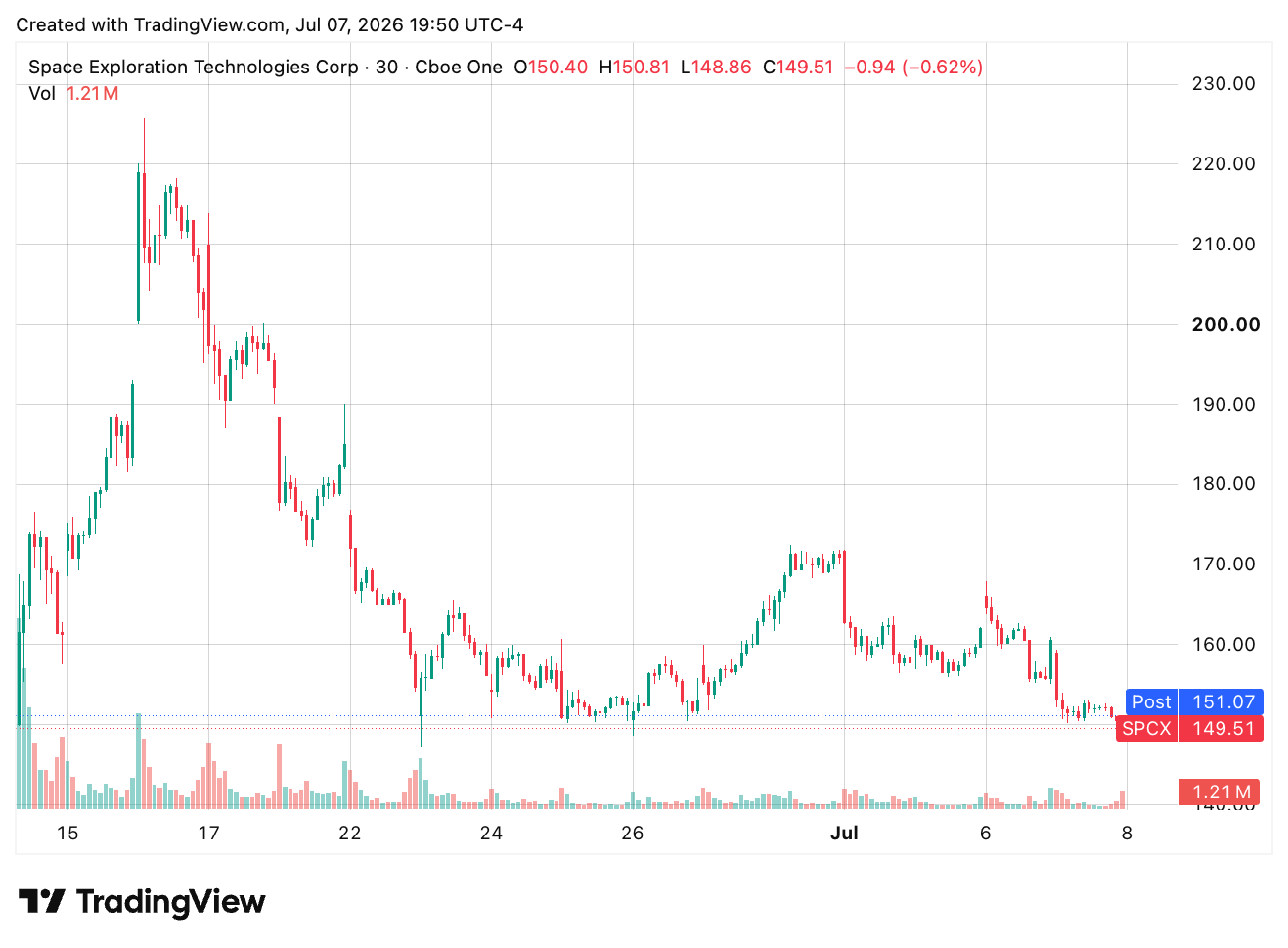
SpaceX went public on June 12 at $135 a share, ripped to almost $226 within four days, and has been bleeding lower ever since. It closed today down almost 7 percent, near $149, a hair above where it started life on the Nasdaq. The largest IPO ever printed, the one that briefly made Elon Musk the world’s first trillionaire, is now round-tripping back toward its debut price while the people who bought the top hold the bag.
That alone would be a story. A hot IPO cooling off is as old as markets. But the reason this one matters has almost nothing to do with rockets, and everything to do with a single line item buried in a regulatory filing days before the stock ever traded. Once you see how that line item works, you cannot unsee it. And it explains far more than one wobbly stock.
So let’s connect the dots.
The deal that showed up right on time
On June 5, a week before the offering, a filing disclosed that Google had agreed to pay SpaceX roughly $920 million a month for AI compute capacity housed in xAI's data centers. That is not a typo and it is not an annual figure. It is nearly a billion dollars, every month, running from October of this year through June 2029. Call it $11 billion a year, landing on the books of a company that was about to ask the public to value it at more than $1.75 trillion.
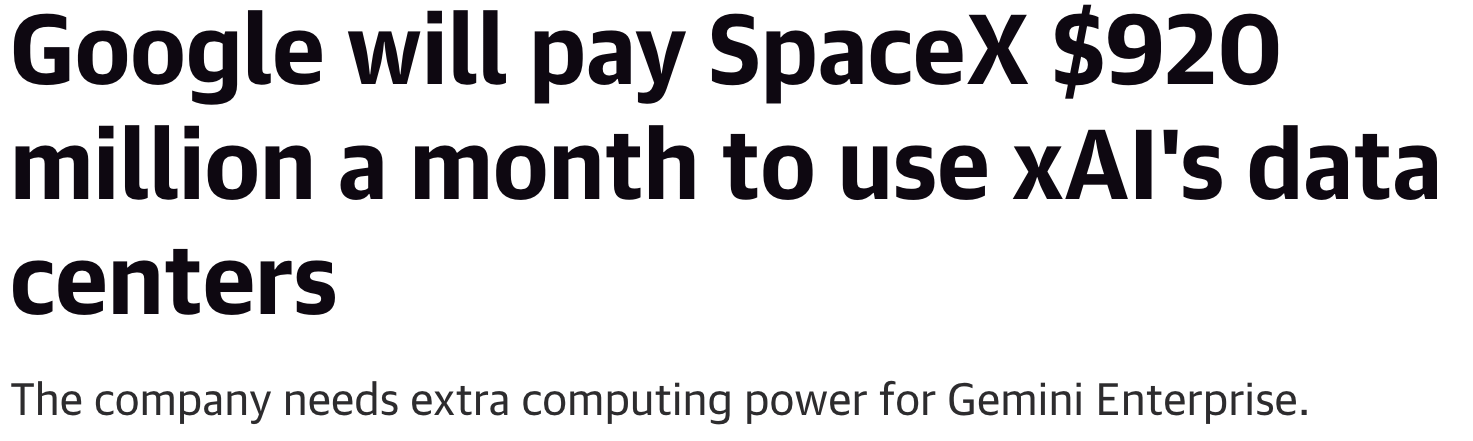
Now, the timing. Google, a company that runs one of the largest cloud businesses on earth and designs its own AI chips, agreed to rent roughly 110,000 Nvidia GPUs from a direct competitor in AI models. Days before that competitor’s IPO. At a price that landed as recurring revenue precisely when a recurring-revenue story was worth the most.
Ask yourself a simple question. If you were selling your business next Tuesday, and a friendly giant offered to sign a multi-year, eleven-figure contract this Friday, one that pumps the exact number your buyers are staring at, would you call that a coincidence? Or would you call it a favor with a very specific delivery date?
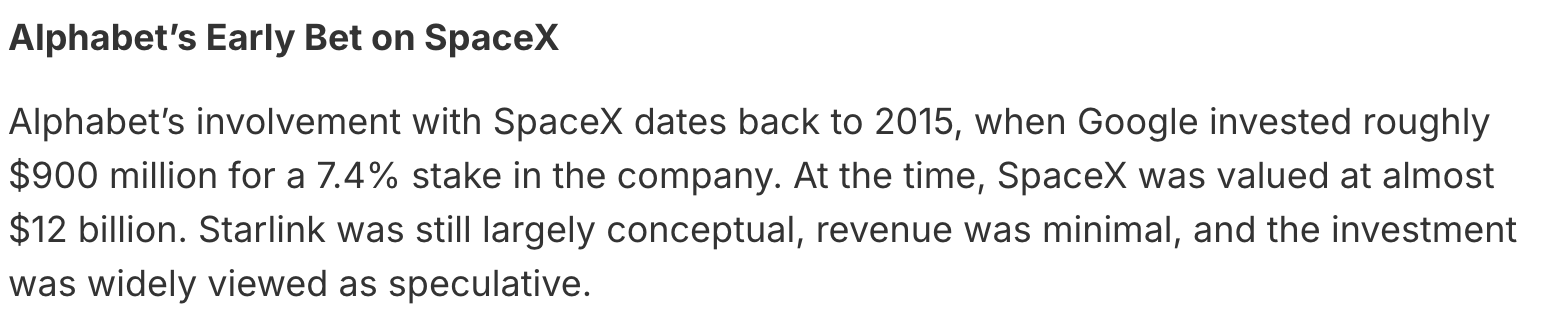
Here is the part that makes it more than a hunch. This was not Google's first move on SpaceX. Alphabet backed the company in 2015, sinking in around $900 million when the whole business was valued at roughly $12 billion. At the IPO, SpaceX was valued north of $1.75 trillion. So the same company writing the $920-million-a-month check is also sitting on a decade-old equity stake that just got marked to a valuation more than a hundred times higher. A commitment to pay eleven billion over several years is a rounding error against what that stake is now worth on paper. You do the math on which number Google cares about more.
And this was not even the first compute deal wheeled out ahead of the offering. A month earlier, Anthropic signed on to use SpaceX’s compute at its Colossus data center in Memphis. Two enormous customer commitments, both materializing in the weeks before the public got to buy. Surging demand, right on schedule.
So what does the average investor, staring at a $1.75 trillion price tag on a rocket company that loses money, actually need to understand before deciding whether the story holds together?
Watch where the dollars actually go
Strip away the drama and look at the shape of it, because the shape is the whole thing.
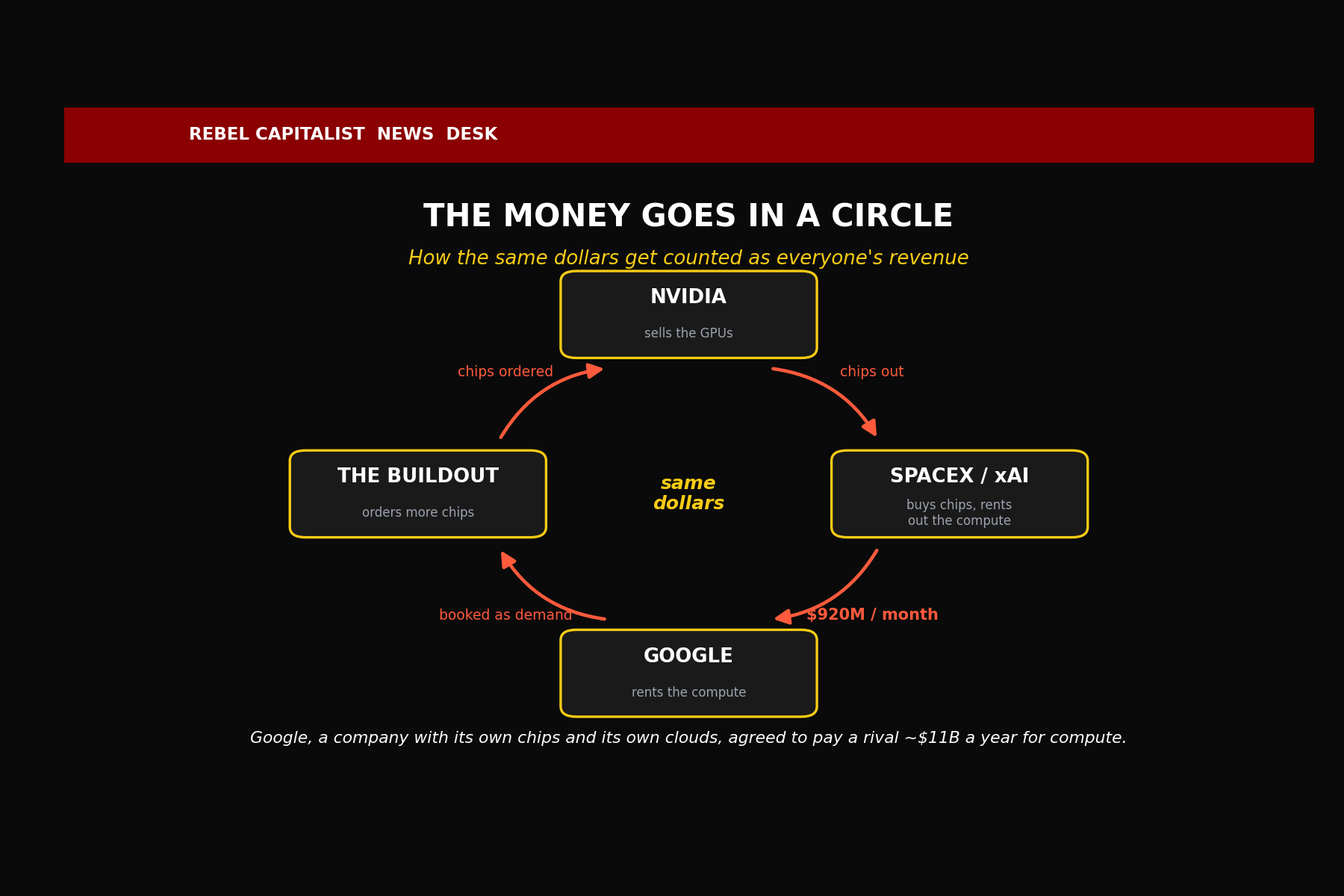
Nvidia sells the chips. SpaceX and xAI buy the chips and stand up the data centers. Google rents the compute those chips provide and pays close to a billion a month for it. That payment lands as revenue, which helps justify buying more chips, which flows back to Nvidia, which has been busy investing in and backstopping the very companies doing the buying. Round and round it goes.
Nobody in this loop is technically lying. Every contract is real, every dollar is disclosed in a filing. That is what makes it so slippery. The genius of it is that a single pile of money can be counted as revenue at one company, as demand at another, and as a growth story at a third, all at the same time, as it moves around the ring. One dollar wearing four hats.
Give the bulls their strongest case here, because it is not nothing. Compute really is scarce. Even hyperscalers with unlimited balance sheets cannot build data centers fast enough to keep up with the permitting, the power hookups, and the construction timelines. Renting capacity that is already switched on is a legitimate way for Google to add compute faster than pouring its own concrete. Google itself framed the deal as bridge capacity for demand it says has outrun its own forecasts on its Gemini Enterprise product. Take that at face value. The AI buildout is real, the demand is real, and some of these deals are exactly what they look like.
But that is precisely where the sleight of hand lives. Because demand and profit are not the same word, and the whole edifice depends on you forgetting the difference.
Surging demand is not a profit
Imagine a business that sells twenty-dollar bills for ten bucks each. What would demand look like? It would go vertical. Your customers would form a line around the block. Your total addressable market would be roughly every human being with ten dollars. You would post the most breathtaking growth curve anyone had ever seen.
And you would go bankrupt.
That is the trap in every “surging demand” headline attached to these AI deals. Huge demand tells you the price is attractive. It tells you nothing about whether the seller makes money, and nothing about whether there is even a path to making money. When the demand exists only because someone is selling compute, or capital, or a story, for less than it truly costs, the demand curve is a distraction. The question that matters is downstream and quieter: does the cash actually come back?
Look at the fundamentals underneath the price and the trap comes into focus.
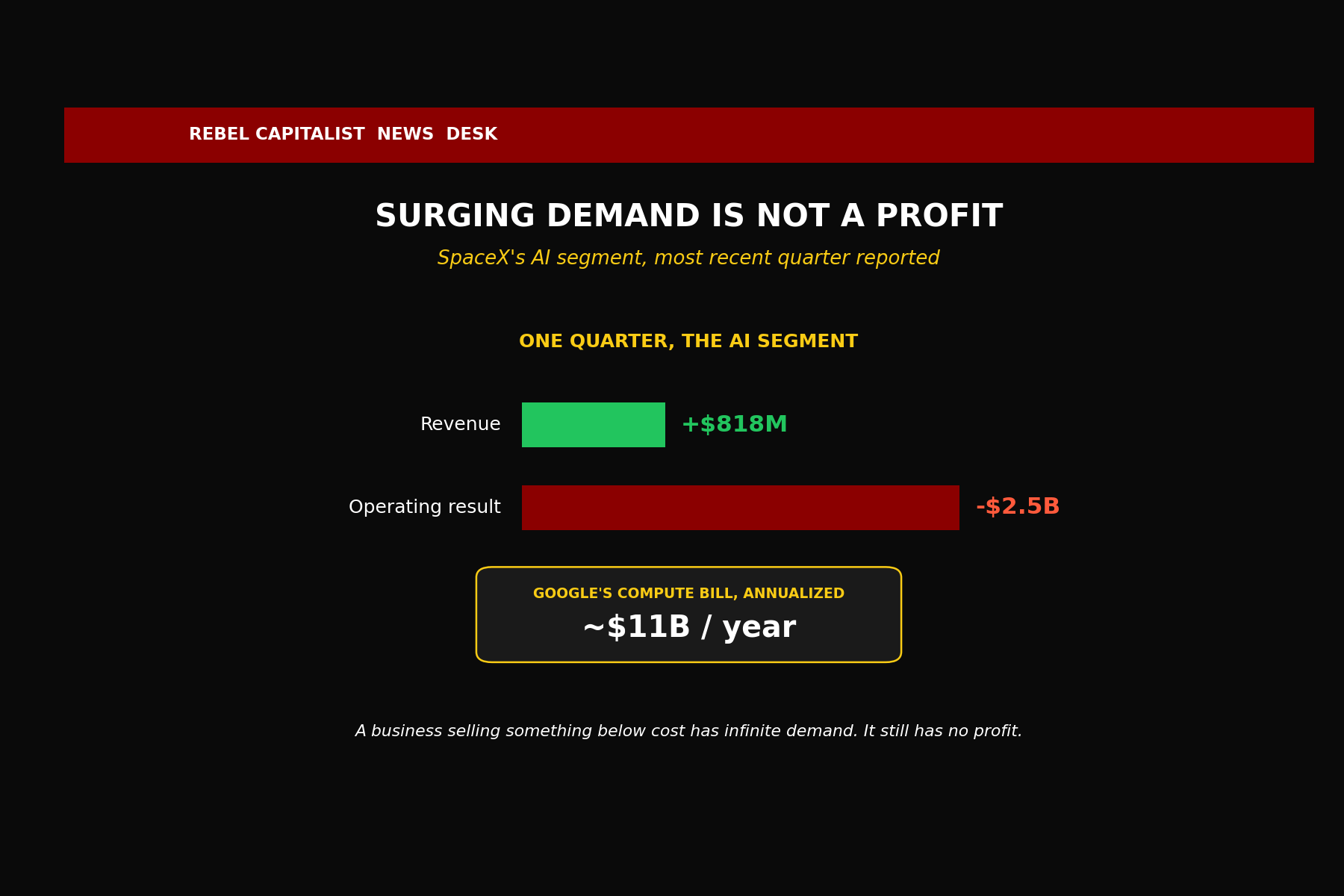
In its most recent reported quarter, SpaceX’s AI segment generated $818 million in revenue and posted a $2.5 billion operating loss. In the same period, company capital expenditures hit $10.1 billion, more than double a year earlier, with $7.7 billion of that poured straight into AI infrastructure. So the segment collecting the demand is losing money at a rate of billions a quarter, while the spending required to keep collecting that demand is running at ten billion a quarter and climbing.
Now set Google’s $920 million a month against that. For the arrangement to make sense as a business rather than a favor, Google needs to extract more value from that compute than it pays. If it turns out Google is paying a rate well above the going market price, and some of the people who read the filing closely think it is, then this is not a customer relationship. It is a subsidy dressed as a sale, timed to a stock offering.
And a subsidy has a shelf life. Read the fine print in the filing and the whole thing is built on quicksand. SpaceX disclosed that if it fails to deliver the committed GPUs by a September deadline, Google can terminate immediately. After this year, either side can walk with 90 days’ notice. So the eleven-billion-a-year headline that helped anchor a trillion-dollar valuation is a contract that can evaporate one quarter after the shares are distributed. Pump the number when it counts. Keep the option to cancel once the selling is done.
That is the mechanism. Not a conspiracy whispered in a back room, but an incentive structure sitting in plain sight in a public document, doing exactly what it was designed to do.
The thing everybody knows and nobody can trade
Here is the uncomfortable part, and the reason this is so hard to act on.
You can see the whole scheme. You can lay out the circle, name the deals, quote the filing, point at the money-losing segment underneath the trillion-dollar tag. And it changes nothing about what the stock does tomorrow, because a game like this can run for years. There is an ocean of capital out there with an enormous appetite for risk, and as long as that appetite holds, the music keeps playing. Pointing at the emperor’s wardrobe does not put clothes on him, and it does not stop the parade.
So the temptation is to short it. Resist that temptation. Trying to stand in front of this thing is like stepping onto the tracks to stop a runaway freight train by holding up your hand. You are correct about where the train ends up. You will still get run over. The tape does not reward being early, it punishes it, and “early” and “wrong” cash out at the same window.
What actually breaks the spell is not an argument. It is arithmetic finally showing up in the cash flows. The day the market decides that the compute Google is renting cannot generate more than Google is paying, that the AI segment has no credible path from a $2.5 billion quarterly loss to daylight, that the demand was always just cheap money circling the drain, the story reprices in an afternoon. Nobody can tell you the date. Anyone who claims to is selling something.
But you can watch for the tells, and this month has produced a cluster of them worth respecting.
What to watch
Start with the stock itself. SpaceX going up and to the right, higher highs and higher lows, would have said the appetite for this game was still bottomless and the ruse had plenty of runway left. Instead it topped near $226 and rolled straight over, giving back nearly a third of its value in weeks. That is not proof of anything on its own. It is a chink in the armor.
Then look at who is quietly heading for the exits. Blackstone, one of the biggest names in data-center buildout, just sold its stake in three Northern Virginia hyperscale data centers and walked away from what was slated to be the largest data-center campus in the country. Meta, which raised its capex forecast to as much as $145 billion this year, is now reportedly building a business to rent out excess compute. Sit with that word. Excess. If demand is truly insatiable, how does anyone end up with too much? Either the demand is not as bottomless as advertised, or the buildout has run ahead of it. Maybe both.
And then there is the broad tape, which has been flashing a signal worth respecting. There is a market tell going back to 1971: when the Nasdaq underperforms the Dow by around 5 percent over a short stretch of trading sessions, the odds of sliding into a bear market run near two-thirds. That is exactly the pattern lately. The tech-heavy Nasdaq keeps taking the losses while the Dow, with far less exposure to the AI names, keeps holding up or hitting records, session after session, as investors rotate out of the most speculative corners. The same nerves tripped a circuit breaker in South Korea, where the Kospi fell hard enough to halt trading, chipmakers leading the way down. The riskiest assets are being sold first. That is usually how these things start.
Two-thirds is not certainty. There are no certainties here, only probabilities, and a two-thirds signal is wrong one time in three. So this is not a call to buy puts on the Nasdaq or to bet the tape is done. Taking a directional swing at a market this reflexive is a fast way to be right on paper and broke in practice.
The honest position is narrower and more useful than a prediction. The circle only spins as long as fresh capital keeps feeding it and everyone agrees not to ask where the cash actually ends up. The line in the sand is the moment that question gets asked in earnest, when one marquee compute deal gets cancelled instead of renewed, when one of these money-losing segments has to show real cash instead of booked demand. Watch the renewals, not the announcements. Watch whether “excess compute” spreads from Meta to the rest of them. Watch whether SpaceX keeps making lower highs. The rockets may well be the future. The financing structure strapped to them right now is a different machine entirely, and machines like this have always ended the same way. The only thing nobody knows is the hour.
Facts > Narrative. Always.
Stand up for freedom, liberty, and free market capitalism.