The Divergence
A Dow-Nasdaq divergence signal just flashed for the first time in years, with a 67% bear market hit rate. Here is what the indicator is actually saying.

![[Section Divider Image]](https://substackcdn.com/image/fetch/$s_!I3TJ!,f_auto,q_auto:good,fl_progressive:steep/https%3A%2F%2Fsubstack-post-media.s3.amazonaws.com%2Fpublic%2Fimages%2F94a44af7-d226-44ab-af38-bad0f854dd58_1320x50.webp "[Section Divider Image]")
There is a number sitting in the market right now that has shown up only a handful of times in fifty years, and almost every time it did, what followed was ugly.
Not a dip. Not a healthy pullback. A bear market. The kind that takes a fifth off the broad index and four-fifths off the high-flyers.
The signal flashed last week. The strange part is not that it flashed. It is where it points, and how few people seem willing to look.
The seven-day signal nobody was watching
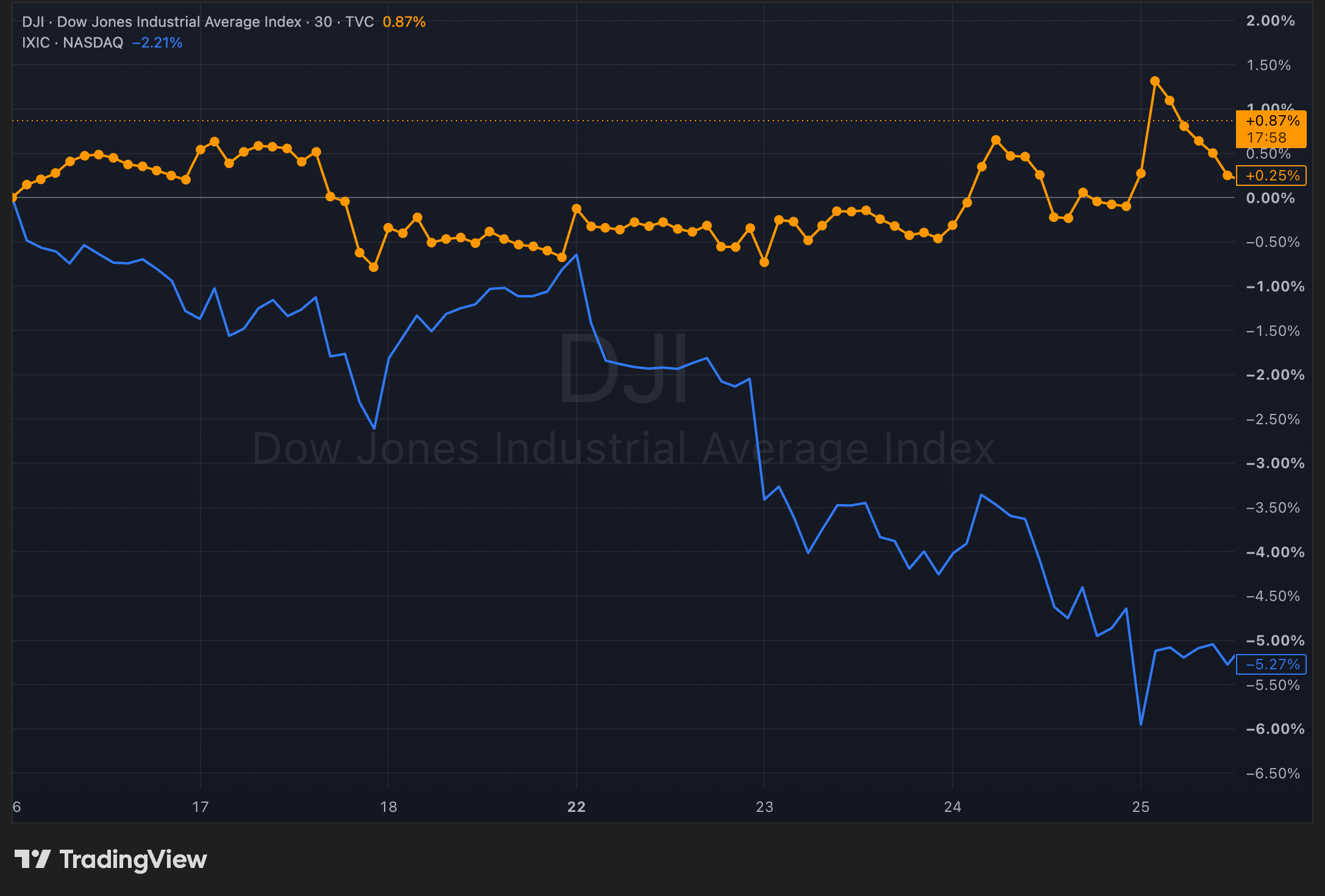
Over the seven trading sessions through June 25, the Dow rose 0.5%. Over the same seven sessions, the Nasdaq Composite fell 5.0%. That is a 5.5 percentage-point gap between the two indexes in a single week.
So what? Indexes diverge all the time. The Dow is thirty old-economy names; the Nasdaq is where the tech lives. Of course they pull apart.
Except they almost never pull apart this hard, this fast. Only about 1% of all trading days since the Nasdaq was created in 1971 have produced a trailing seven-day spread wider than the one just recorded. That is a once-every-few-years reading. And the company it keeps deserves attention.
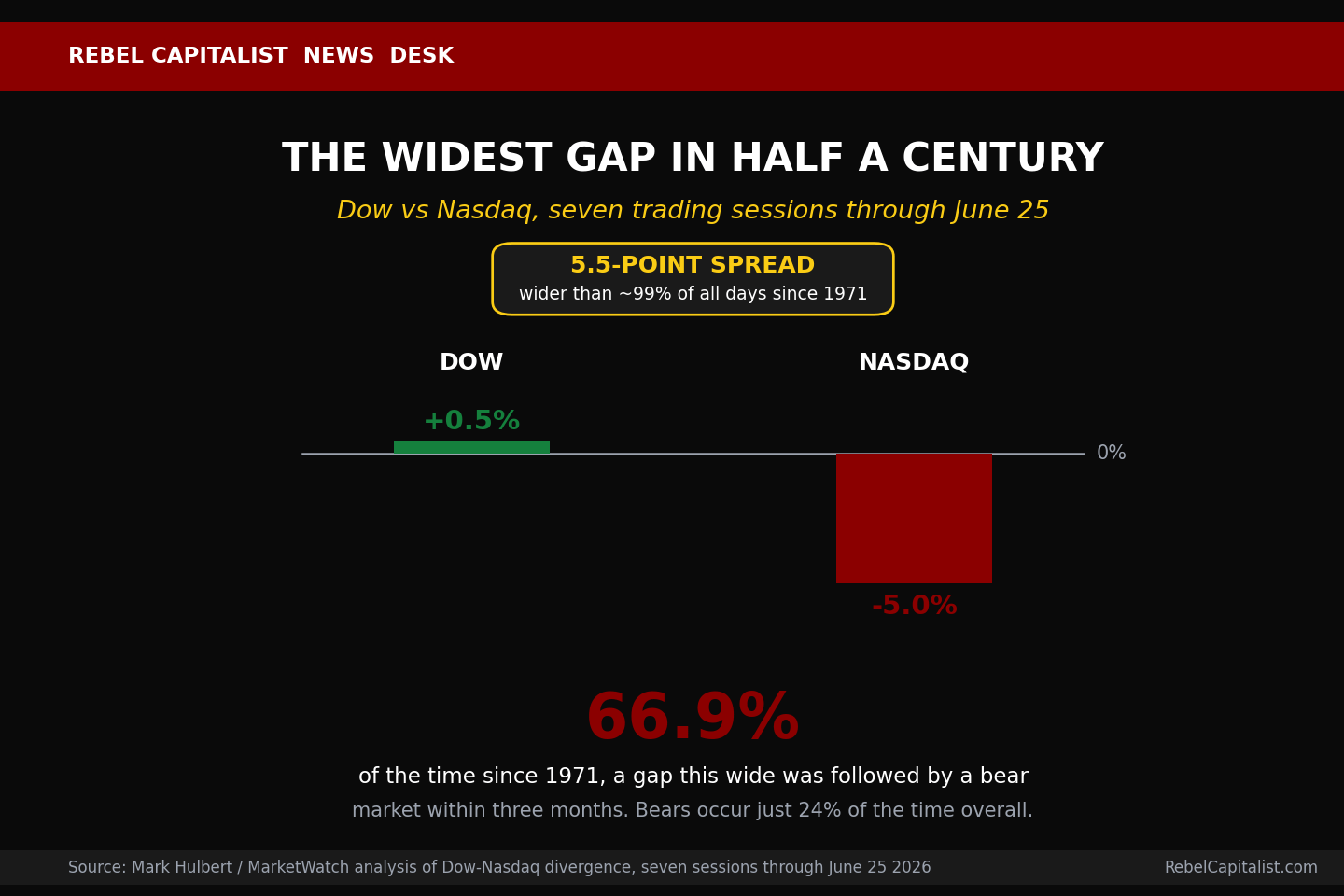
When the gap has been this wide, the market was in a bear market within three months 66.9% of the time going back to 1971. Round it and you get the headline: a 67% chance.
Now give that number a baseline, because a number with no baseline is just a number. Across the whole history of the series, the market has been in a bear market only about 24% of the time. One-in-four. When this divergence shows up, the odds nearly triple. That is the entire claim. Not a prophecy. A conditional probability that moves from one-in-four to two-in-three when one specific thing happens. And that one thing just happened.
The cleanest illustration still makes tech investors flinch. In the ten sessions right before the March 2000 dot-com top, seven showed a divergence as large or larger than last week’s. In the bear market that followed, the Nasdaq lost almost 80%.
Don’t shoot the messenger. This is not a forecast pulled from thin air. It is the historical record of what tends to follow a rare condition. The condition is present. The question is whether anything underneath the market explains why it would persist, which turns this from a chart trick into a story about how the whole thing is wired.
Why the divergence isn’t random
A healthy bull market is broad. The boring industrials, the banks, the chipmakers, the speculative moonshots, all grinding higher together. When the generals march one way and the troops collapse the other, that is not strength rotating politely. That is money leaving the riskiest corner of the market for the safest one that still counts as stocks.
And which corner is the riskiest right now? The one that has carried the entire index for two years. AI. The Nasdaq is where the AI trade lives, and so is the tech-heavy slice of the S&P. When the gap opens with the Dow firm and the Nasdaq getting hit, you are watching the market quietly re-price the most crowded, most story-dependent trade of the cycle. The divergence is not random. It is the AI trade and the rest of the market starting to trade like two different animals.
Which would be a footnote, except this week the world’s most cautious financial institution put out a report saying almost the same thing.
When the central banks’ central bank rings the bell
On June 28, the Bank for International Settlements published its 2026 Annual Economic Report. The BIS is the institution central banks themselves answer to, the one in Basel that does not do hysteria. This time it named names.
The report flagged the bursting of an AI bubble and the collapse of opaque “circular” financing deals as among the top risks to the global financial system. Combined capital spending by the five largest hyperscalers is on track to clear a trillion dollars across 2025 and 2026. And in the BIS’s own words, disappointment in AI returns could trigger a sudden pullback in financing and turn the capex boom into a protracted investment bust.
The buildout propping up the market is, by the BIS’s own account, financed in a way where the same asset can be pledged more than once. That is not a sturdy expansion. It works beautifully right up until the financing slows, then runs in reverse just as fast.
So you have two independent signals pointing the same way. A fifty-year price divergence from the chart. The central banks’ own institution from the fundamentals. Same fault line, opposite ends.
If both say watch the AI trade, the real question is not whether the indicator is spooky. It is what would have to break for the 67% to become the base case instead of the warning. One mechanism turns this from a market story into an economy story, and most of the people quoting the number have not connected it yet.
CONTINUE READING: Below the paywall, the circle the BIS is quietly warning about drawn out in plain English, the one company whose filings show the loop better than any chart, the single data release this week that flips the probability and it isn't the Fed, why a drop now hits the real economy harder than the dot-com bust ever did, and the one condition that would tell you this is the real move and not a two-week head fake.
Join us beyond the paywall, if you haven't done so already.