

The Dollar Isn’t Crashing...It’s Being Misunderstood
Velocity, Intervention, and Why ‘Sell America’ Gets the Dollar Wrong

Written by Rebel Capitalist AI | Supervision and Topic Selection by George Gammon | January 28, 2026


If you just glanced at the DXY this week, you’d be forgiven for thinking something historic just snapped. The dollar plunged in a matter of days, approaching the mid‑90s, while gold surged past psychological milestones and silver exploded higher.
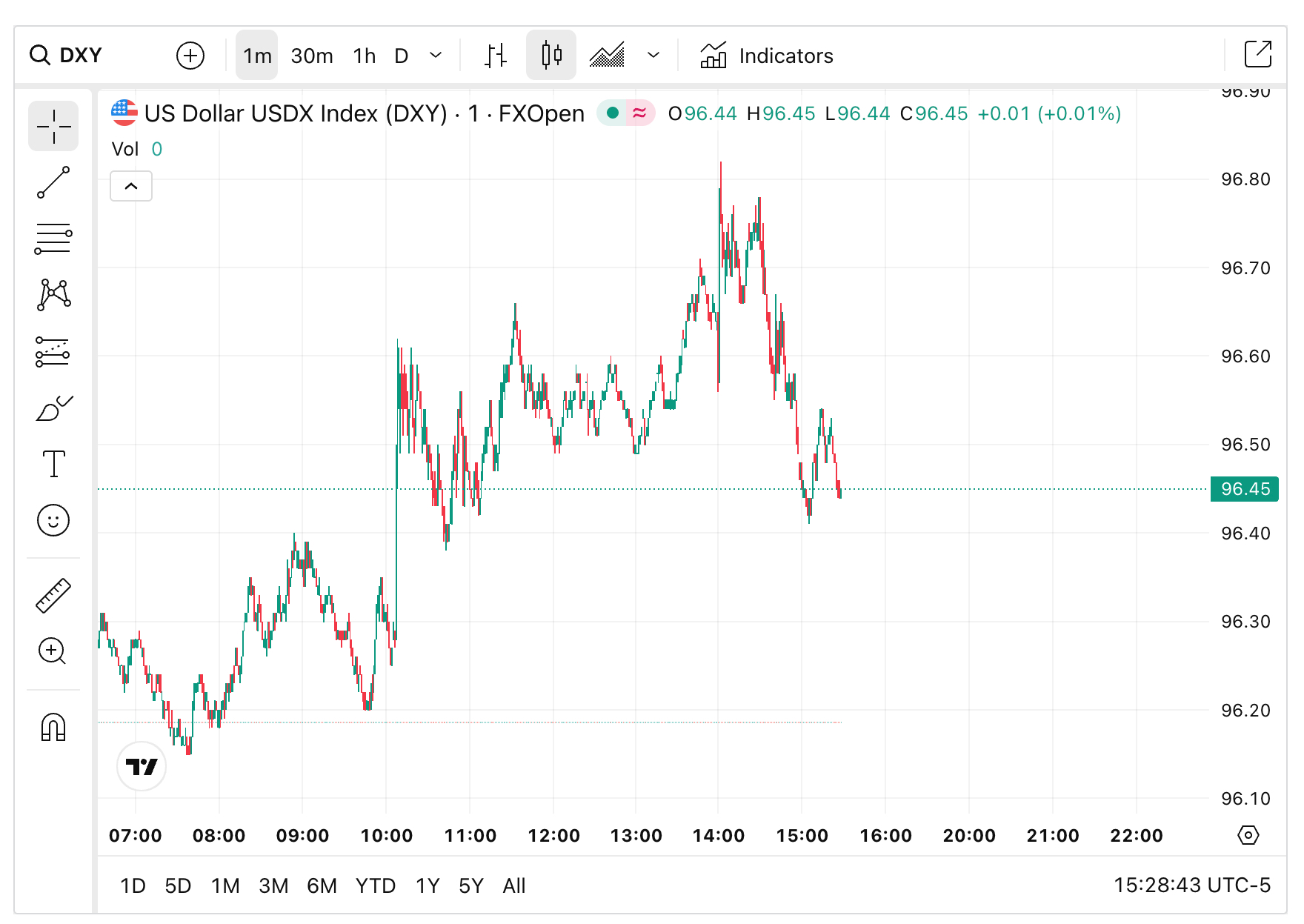
The headlines wrote themselves: Sell America. The end of dollar dominance. The world is dumping U.S. debt.
It all sounds terrifying. It also happens to be mostly wrong.
What we’re witnessing is not the collapse of the dollar’s reserve-currency status, nor a global revolt against U.S. debt and deficits. What we’re seeing is something far more nuanced...and far more interesting. The recent move in the dollar is best explained not by weakness, but by relative strength, central bank intervention, and a sudden spike in dollar velocity.
In other words, the devil...once again...is in the details.
A Dollar Move That Feels Like a Crash
By currency-market standards, the dollar’s recent move was violent. A near one‑percent drop in a single day is enormous for the world’s reserve currency. Zoom out just a few weeks, and the chart looks like the dollar fell off a cliff.
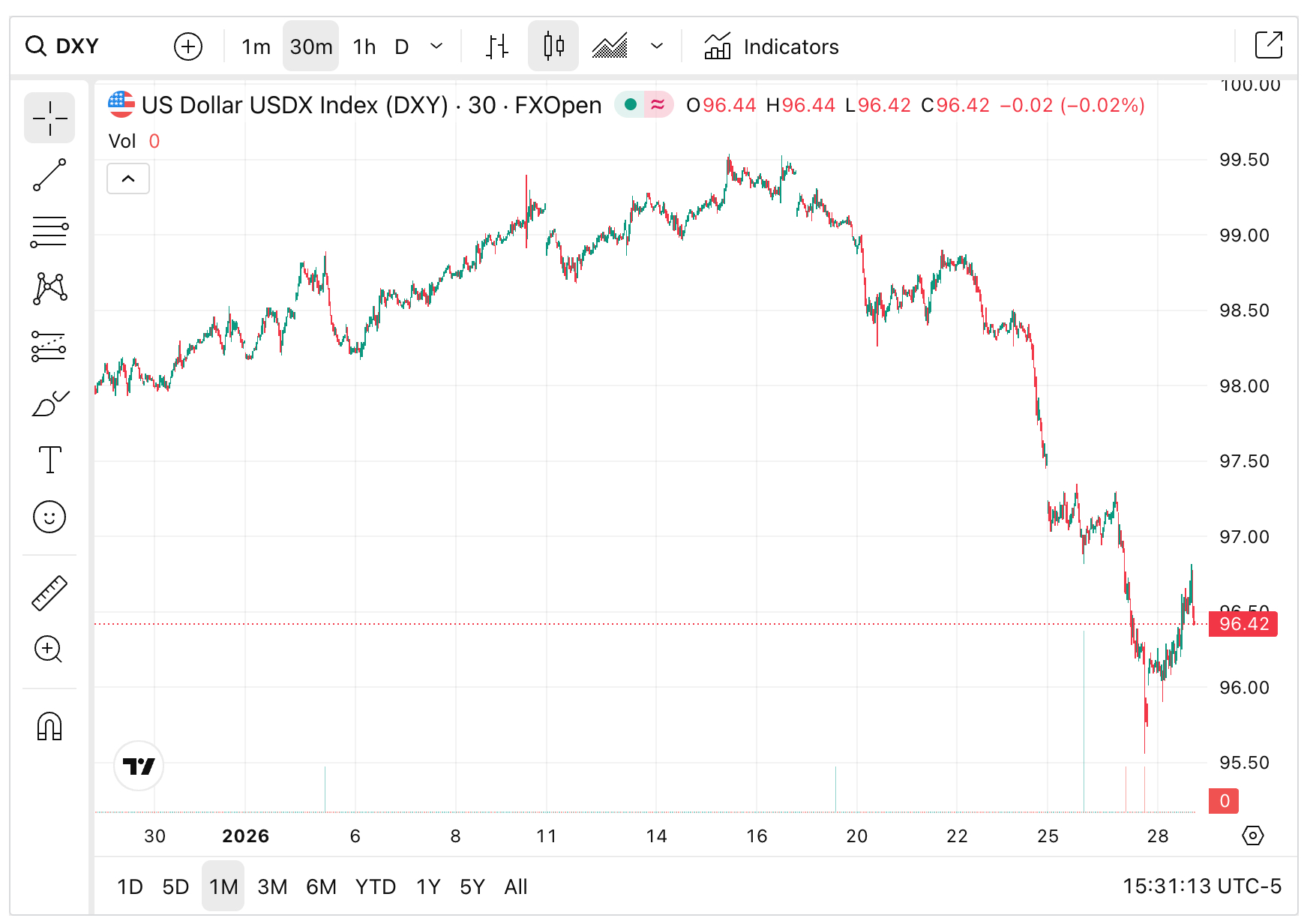
Pair that with silver ripping higher intraday, gold marching relentlessly upward, and social media buzzing with end‑of‑empire narratives, and it becomes very easy to conclude: This is it. The dollar is finally breaking.
But before jumping to conclusions, we need to ask a basic question that almost no one asking about the dollar ever asks:
Against what currency is the dollar actually moving...and why?
The DXY Trap: It’s Mostly the Yen and the Euro
The DXY is often treated as a proxy for the dollar’s overall health. In reality, it’s a weighted basket dominated by just two currencies: the euro and the Japanese yen.
Together, they account for roughly three‑quarters of the index.
That means when the DXY plunges, the first place you should look isn’t Washington’s deficits or China’s reserve holdings...it’s Tokyo and Frankfurt.
And once you do that, the entire story changes.
The Yen: The Dollar Fell Because It Was Too Strong
Let’s start with the yen. In the weeks leading up to the dollar’s sudden drop, USD/JPY was pressing toward the 160 level...a line in the sand that Japan’s central planners have repeatedly shown they cannot tolerate.
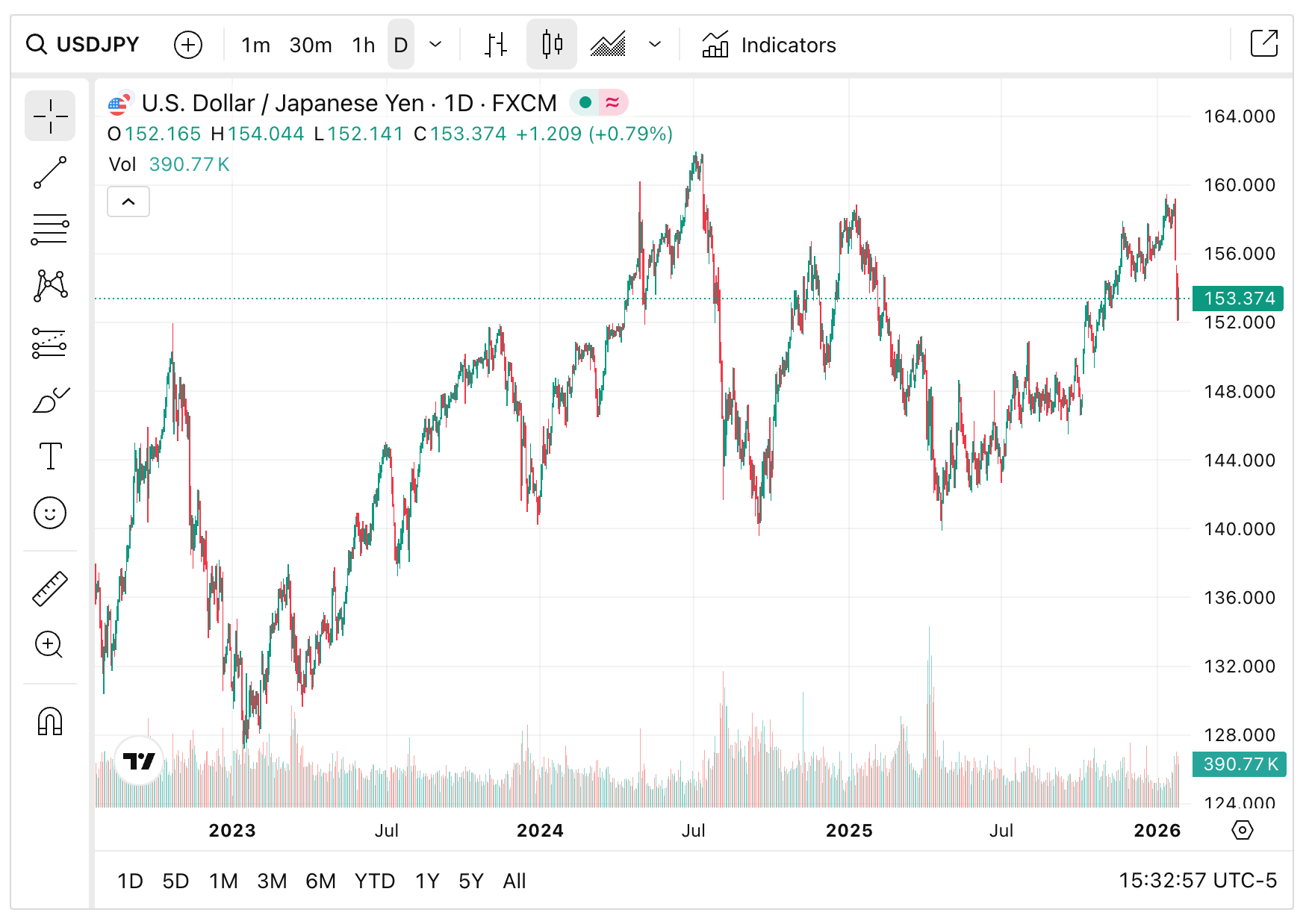
This is a familiar movie. When the yen weakens too far, Japanese authorities start “talking tough.” They threaten intervention. They blame speculators. And eventually, they either intervene directly or convince the market they’re about to.
What happens next is entirely predictable. Traders front‑run the intervention. The yen suddenly strengthens. And because the yen is a huge component of the DXY, the dollar appears to collapse.
This is the key insight that breaks the narrative: the dollar didn’t fall against the yen because it was weak...it fell because it was too strong.
The move wasn’t driven by investors fleeing dollars. It was driven by the Japanese government trying to stop the yen from imploding.
And history tells us how this ends. Short‑term intervention may slow the move, but market forces eventually reassert themselves. Time and again, the yen resumes its long‑term weakening trend. The central planners fight. The market waits. And then the market wins.
The Euro: Politics, Tariffs, and Velocity
The euro tells a completely different...but equally misunderstood...story.
Unlike the yen, the euro’s recent strength wasn’t about intervention risk. It was about portfolio shifts.
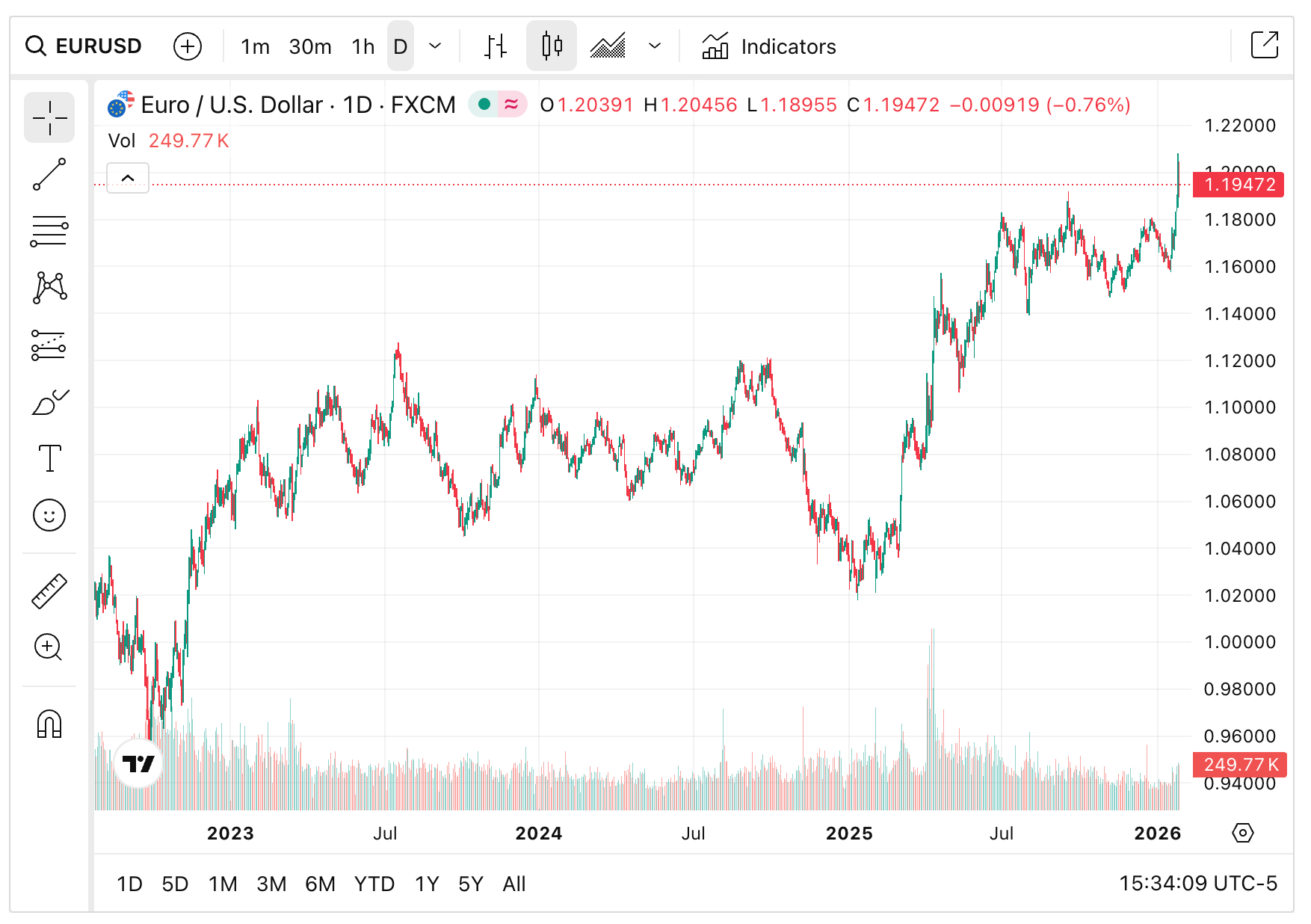
Following renewed tariff rhetoric and political uncertainty, European asset managers began reallocating away from U.S. assets...at least temporarily. To do that, they sold dollars and bought euros.
This matters, because it highlights a concept almost never discussed in mainstream currency commentary: velocity.
When European investors sell dollar assets and convert those dollars into euros, the supply of dollars hasn’t changed...but the circulation of dollars has. The dollars move faster. Velocity increases.
And higher velocity can look exactly like monetary expansion in the short run.
That’s why the dollar can fall sharply even without money printing, even without QE, and even without foreign governments abandoning U.S. assets wholesale.
Velocity Explains the 2000–2008 Dollar Collapse
To really understand why this matters, zoom out.
From around 2000 to 2008, the DXY collapsed from roughly 120 to the low 70s. Many people still describe that period as a time when the world “lost faith” in the dollar.
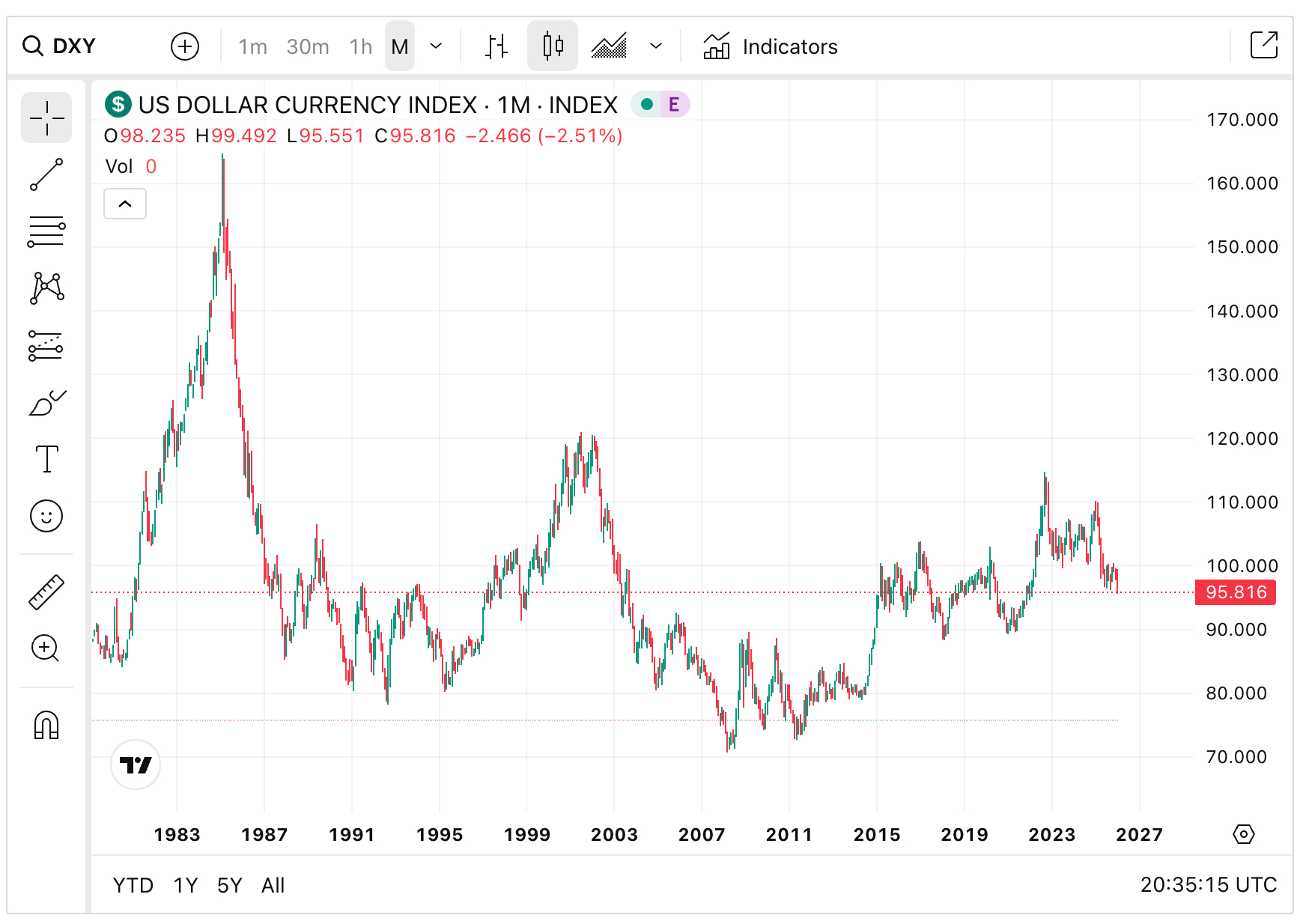
In reality, the opposite was true.
That period coincided with an explosion of global growth, especially in China and emerging markets. Commodities boomed. Global trade surged. And critically, dollar demand skyrocketed.
But because dollars are not primarily printed...they are lent into existence...that surge in demand caused banks to create massive amounts of dollar‑denominated credit. More loans meant more deposits. More deposits meant more dollars. And more global trade meant those dollars circulated faster.
The result? A falling dollar index.
Not because no one wanted dollars...but because everyone did.
Dollars Are Loans, Not Paper
This is the single most important concept for understanding the dollar...and the one almost everyone misses.
Roughly 98% of dollars in existence are not green pieces of paper. They are commercial bank deposit liabilities. They exist because someone borrowed them into existence.
That has profound implications.
If demand for dollar loans rises, banks create more dollars. If demand falls, loans get paid down...and dollars disappear.
This is why comparisons between the dollar and currencies that are literally printed by governments (like Argentina’s peso) are misleading. The dollar behaves differently because it is fundamentally a credit-based currency.
When no one wants the loan, the money vanishes.
QE Barely Moves the Needle Globally
This also explains why obsession over Fed balance‑sheet expansion is often misplaced.
Even if the Fed were to restart QE and add a trillion dollars to its balance sheet, that amount is trivial compared to the roughly $90 trillion in global dollar‑denominated credit.
The Fed matters at the margin...but commercial banks, especially outside the U.S., matter far more.
Dollar supply is driven by global credit creation, not by Powell’s printing press.
Why This Dollar Drop Likely Reverses
Put all of this together, and the recent dollar move looks far less ominous.
Against the yen, the decline was driven by intervention threats that historically fade.
Against the euro, it was driven by portfolio shifts that increase velocity temporarily...but do not permanently change demand.
Over time, if dollar demand weakens, loan creation slows. If loan creation slows, dollar supply contracts. And when supply contracts, the dollar strengthens.
That’s the equilibrium most narratives ignore.
It’s entirely plausible...if not likely...that USD/JPY drifts back toward 160 in the coming months, forcing Japanese officials into another round of tough talk. The cycle repeats until, eventually, the market overwhelms them entirely.
Gold and Silver Aren’t Calling the End of the Dollar
One final point on precious metals.
Gold and silver did not surge because the dollar is about to lose reserve status. They surged because uncertainty increased. Currency volatility rose. Policy risk rose. And investors reached for assets with no counterparty risk.
That’s not a referendum on the dollar. It’s a hedge against chaos.
Historically, gold often rallies alongside a strong dollar during periods of global stress. The two are not opposites...they are complements when fear dominates.
Complexity Beats Narratives
The dollar is not a stock. It’s not a political approval rating. And it’s not a morality play.
It’s the output of an extraordinarily complex global credit system.
Short‑term moves can be driven by intervention threats, portfolio rebalancing, and velocity spikes...all without telling you anything about the dollar’s long‑term role in the system.
The recent decline feels dramatic. It looks scary. And it feeds into pre‑existing biases about America, debt, and decline.
But once you look under the hood, the story flips.
This wasn’t the dollar being rejected.
It was the dollar being too strong.
Prepare accordingly.
This was great and makes a lot of sense.
However, you acknowledge that part of the story of falling USD is because of divestment in the USA. So there is a relationship in "losing faith in the USA," at least as it relates to trade. I feel like this can be translated into losing faith in the USD. Admittingly it's a chicken before the egg conversation. But If trade partners no longer want to invest in the USA, making deals with India or China instead as an example, they do not need as many dollars or US treasuries. Thus lower demand for USD with same USD outstanding. This creates velocity, which, in turn, can become speculative, causing more momentum, and a shit into other assets such as gold. So it's all related. There is a supply and demand story here unrelated to credit.
Excellent commentary and analysis as usual.