

The Precious Metals Crash Wasn’t Random
It Was a Cockroach Moment (And the Fed Is the Root Cause)

Written by Rebel Capitalist AI | Supervision and Topic Selection by George Gammon | February 4, 2026
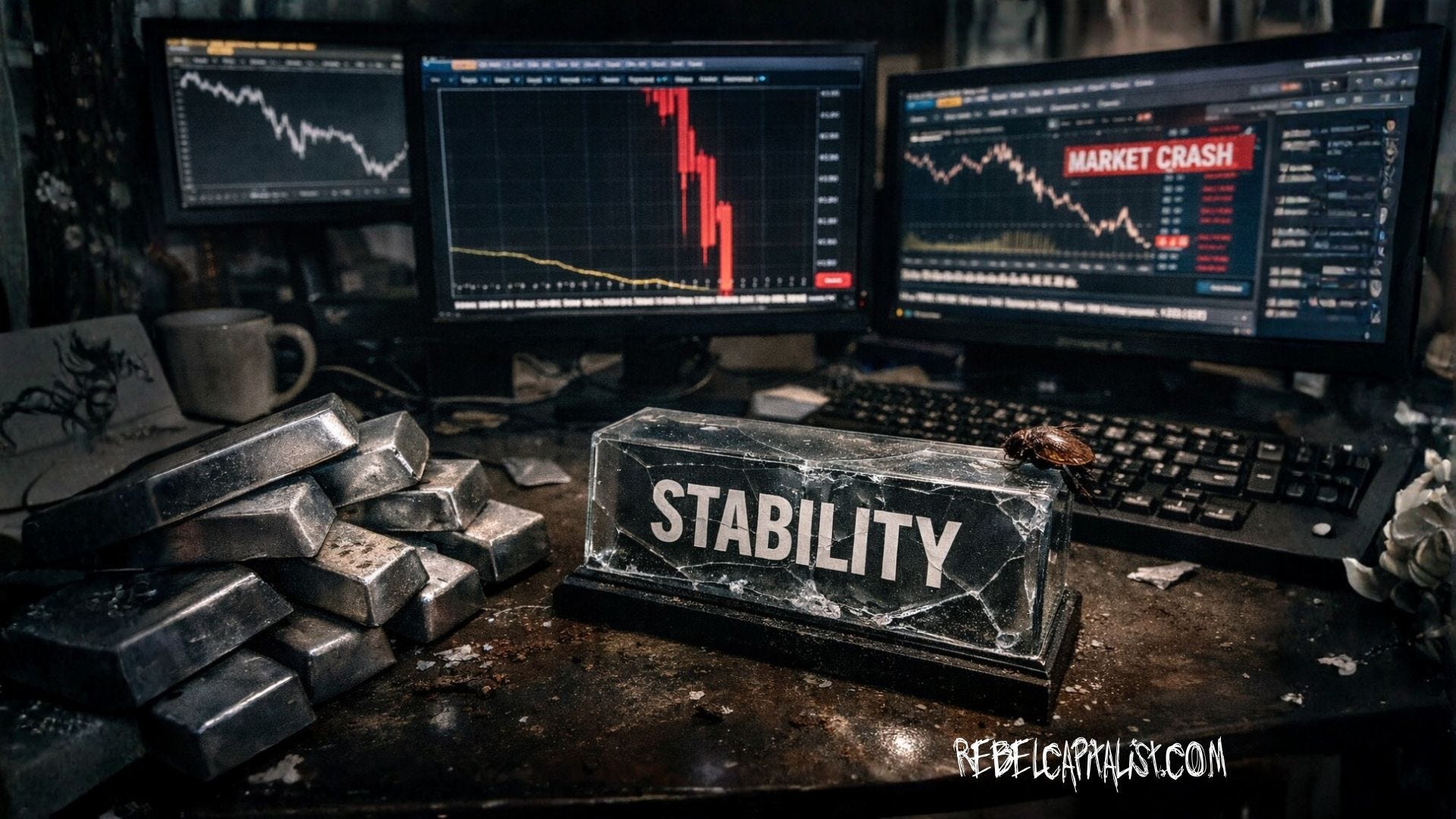

If you only looked at the headlines last Friday, you might think gold and silver simply “did what volatile assets do.” Another day, another selloff. Move along.
That interpretation could not be more wrong.
What we just witnessed in precious metals was not normal volatility, not a routine correction, and not something traders will forget anytime soon. By the admission of veteran market participants...people who have studied this space for decades...the intraday price action in gold and silver was unprecedented, exceeding even the volatility seen during the infamous Hunt Brothers episode.
This was historic.
And history never happens without a reason.

At the peak, silver was trading north of $120 per ounce. By Friday’s close, it was down roughly 30% intraday...an almost unheard-of move for a market of this size and maturity. Gold followed with a violent drawdown of its own, plunging more than 20% from its record highs in a matter of hours.
Even more bizarre was where the selling occurred.
The quoted futures price collapsed, yet physical spot prices...especially in over-the-counter London markets...remained significantly higher. That divergence matters. According to Keith Weiner of Monetary Metals, sustained bull markets in precious metals tend to be healthiest when spot prices trade above paper prices, not the other way around.
In other words, the fundamentals didn’t break.
The structure did.
This Wasn’t the End of a Bull Market
Let’s be clear: violent selloffs do not automatically signal the end of a bull cycle. In fact, history suggests the opposite.
During the Global Financial Crisis, silver fell roughly 50%, while gold dropped close to 30%...right in the middle of what turned out to be a decade-long bull market that culminated in silver approaching $50 in 2011.
Those drawdowns didn’t mark the end. They marked a reset.
The move we just experienced may simply be a hyper-condensed version of what previously played out over months...compressed into days by leverage, derivatives, and speculative positioning.
That doesn’t make it any less painful. But it does make it familiar.
The Unprecedented Volatility Was the Tell
One of the most important signals wasn’t the direction of prices...it was the speed.
Seasoned traders who study historical volatility noted that last Friday’s intraday ranges exceeded anything seen in modern precious-metals history. These are not the kinds of moves driven by retail investors or gradual shifts in macro expectations.
They are driven by forced liquidation.
And forced liquidation always has a cause.
The Convenient...but Wrong...Narrative
The mainstream explanation quickly settled on an easy story: Trump’s rumored pick for Fed chair is more hawkish, the dollar strengthened, and therefore gold and silver collapsed.
That explanation falls apart almost immediately.
If markets truly believed a more hawkish Fed was imminent, short-term interest rates would have risen. Instead, the yield on the 2-year Treasury fell sharply on Friday...by roughly four basis points.
That is not the market pricing in tighter monetary policy.
That is the market pricing in stress.
The Two-Year Treasury Told the Truth
The two-year yield is one of the cleanest barometers of near-term Fed expectations. When it drops, it signals the market believes rates are too high given economic conditions.
Friday’s move was unequivocal.
Rather than fearing a hawkish Fed, the bond market was screaming that the Fed is already behind the curve.
So if this wasn’t about Trump, and it wasn’t about hawkishness, what was it about?
Enter the Cockroaches
While traders were fixated on metals prices, something else happened quietly in the background: the first U.S. bank failure of 2026.
It was a small institution...roughly $225 million in assets...but size is irrelevant. In systemic terms, small failures are not isolated events. They are signals.
George has used this analogy repeatedly: you never see just one cockroach.
When a highly leveraged, risk-on environment begins to unwind, the weakest entities fail first. Those failures force larger players to reassess risk, reduce leverage, and unwind crowded trades.
Precious metals...stuffed with speculative leverage after a parabolic run...were a natural casualty.
Why the Fed Is Still the Root Cause
It’s tempting to accuse the Fed of direct market manipulation whenever something this violent occurs. But that’s not what’s happening.
The Fed’s influence is more subtle...and far more damaging.
By repeatedly bailing out markets, from Long-Term Capital Management in the late 1990s to 2008, to the pandemic, the Fed has taught financial institutions a dangerous lesson: risk is rewarded, losses are socialized.
That creates perverse incentives.
Instead of lending into the real economy...where profits are capped and losses are possible...banks and large institutions deploy balance-sheet capacity into the financial economy, where upside is massive and downside is minimal.
That’s the definition of asymmetry.
The K-Shaped Economy and Speculative Excess
The result of this policy framework is a K-shaped economy.
Asset owners thrive. Speculation flourishes. Leverage builds.
Meanwhile, the lower half of the income distribution falls further behind, watching asset prices soar while real opportunities vanish. Eventually, frustration turns into desperation...and desperation fuels speculation.
That psychology pushes markets into parabolic moves that are structurally unstable.
Friday was the inevitable consequence of that instability.
Candlesticks Don’t Lie
One of the clearest technical signals of excess was the size of recent candlesticks in silver-related instruments like PSLV.
Healthy bull markets climb steadily. Candlesticks remain relatively small. Pullbacks are orderly.
What we saw instead were massive gap-ups and outsized daily ranges...classic signs of unsustainable momentum.
When price moves get that extreme, they don’t resolve gently.
They snap.
Why This Doesn’t Invalidate the Bull Case
Paradoxically, the very violence of this move may make the longer-term bull case stronger, not weaker.
Excess leverage has been flushed.
Speculative froth has been punished.
Weak hands have been shaken out.
That’s how durable trends reset.
If precious metals are truly in the middle innings of a multi-year bull market...as historical analogs suggest...then corrections like this are not only normal, they’re necessary.
What to Watch Next
Going forward, the key is not guessing bottoms. It’s watching structure.
Healthy recoveries are marked by:
Smaller candlesticks
Higher lows
Gradual trend formation
Unhealthy rebounds are marked by violent snapbacks and renewed parabolic moves.
Patience matters.
Final Thought: Blame the Incentives
The Fed didn’t smash the sell button on Friday.
But it did create the environment that made Friday inevitable.
By suppressing downside risk for decades, central planners incentivized leverage, speculation, and fragility. When the system finally hiccups, the unwind is brutal.
The precious metals crash wasn’t random.
It wasn’t manipulation.
It was a cockroach moment.
And cockroach moments only happen in systems built on perverse incentives.
Prepare accordingly.
Silver - You have left out - that the new contracts were only put on COMEX when Shanghai was closed and London winding up. That these contacts were vast. That the automatic circuit breaker that is supposed to kick in any 10% variance in an hour was taken off the COMEX. That JP Morgan off loaded a huge silver short position almost exactly at the bottom of the price for that day. Draw your own conclusions... That said recent gains in AU & AG had probably gotten ahead of themselves and a more steady market is more healthy and fundaments have not change since last Thursday..
Someone else labelled it as an orchestrated grind down to allow some trades tocbe cleared. Selling at just enough pace to avoid trading halts but applied over several hours. Notably JP Morgan settled a load of trades at 78usd.... And hey presto gold and silver bounced right back within 3 days. But nobody will be held to account for this market price manipulation