



![[Section Divider Image]](https://substackcdn.com/image/fetch/$s_!Mk13!,f_auto,q_auto:good,fl_progressive:steep/https%3A%2F%2Fsubstack-post-media.s3.amazonaws.com%2Fpublic%2Fimages%2F8a6e71e9-a67d-4a3e-bf58-cf9d179b5ebf_1320x50.webp "[Section Divider Image]")
Everyone spent the spring waiting for the dollar to die.
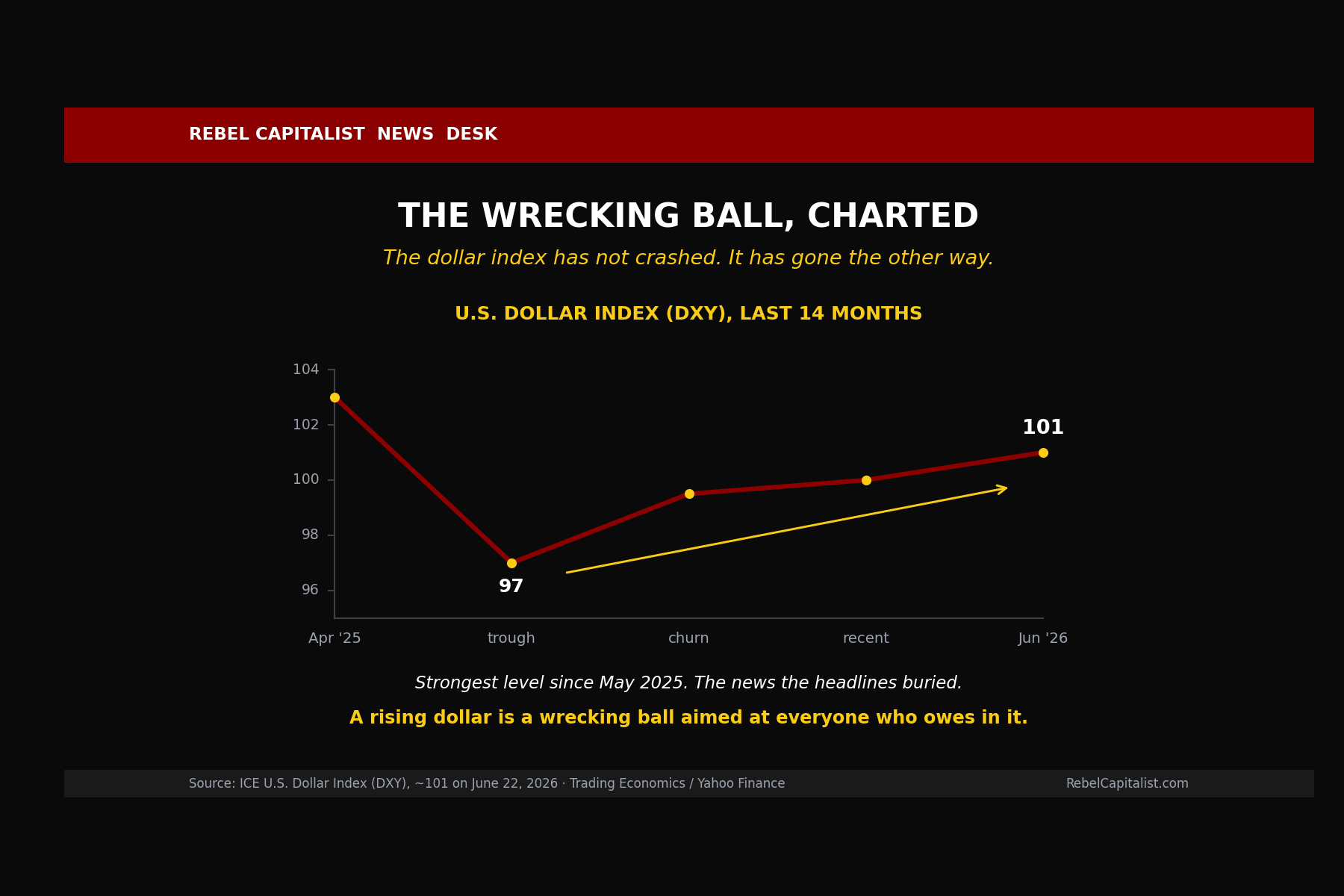
Go back to April 2025. The dollar index had rolled over hard, sliding from around 108 down to 97, and the usual voices came out swinging. The gold bugs. The Bitcoin crowd. A few genuinely serious macro names. The dollar is crashing, they said, and for a few weeks the chart agreed with them. The greenback was finished. The end of dollar hegemony was finally here.
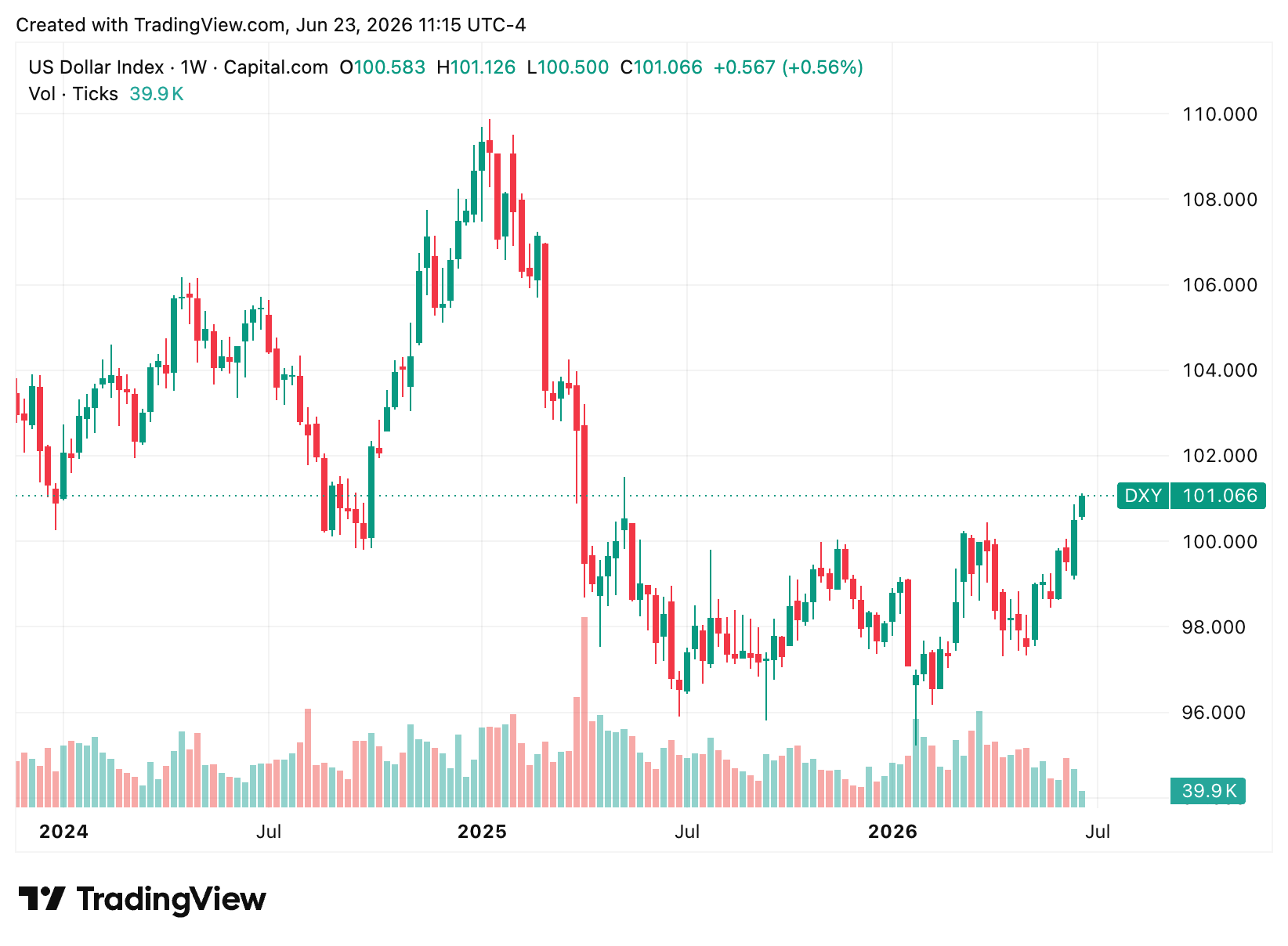
Fast forward to today. The dollar index just printed its strongest level in over a year, sitting right around 101 as of June 22, having climbed steadily for weeks while almost no one was watching. Not crashing. Climbing. And the same crowd that was throwing a funeral in April has gone strangely quiet.
So which is it? Is the dollar dying, or is it the strongest it’s been since the middle of last year?
It’s both, depending on which dollar you’re talking about. And that distinction is the whole game.
Two Dollars, And Only One Of Them Is In The News
Here’s the trap most people fall into. Mention that the dollar is “going up” and somebody immediately fires back that they just paid four bucks for a coffee, so what on earth are you talking about. Fair enough. That person is measuring the dollar against goods and services inside the United States, and on that scorecard, yes, the dollar buys less every year.
But there’s a second dollar. That’s the dollar measured against other currencies. The euro, the pound, and above all the Japanese yen. That’s what the dollar index, the DXY, actually tracks, and it’s roughly 57% euro and about 14% yen by weight. These two dollars can move in completely opposite directions at the same time, and they frequently do.
Now, the natural reaction from most Americans is to file this under “not my problem.” The DXY is just a number on a screen. It doesn’t show up at the gas pump or in the rent. Why allocate any mental bandwidth to it?
Because that number is a wrecking ball. And the demolition is happening right now, in plain sight, to the economies the United States trades with. To see why a strong dollar is doing real damage on the other side of the planet, and why that damage has a return address, you have to follow what it’s doing to one currency in particular.
Why The Yen Is The Canary
Pick Japan, not because it’s special, but because it’s the cleanest example of a mechanism that’s quietly stressing economies all across Asia and beyond.
Start with one fact almost everyone forgets: oil is priced in dollars. When a Japanese refiner buys a barrel of crude from Saudi Arabia, the seller does not want yen. You can walk into a Tokyo dealership and buy a Porsche with a suitcase of yen all day long, because that Porsche is priced in yen at the point of sale. Try the same thing with a barrel of Saudi crude and you’ll get the same look you’d get slapping a fistful of yen on the counter at an American gas station and asking them to fill the tank. They don’t take yen. They take dollars.
So picture a refiner. The price of oil in dollar terms hasn’t moved an inch. But the yen has fallen against the dollar. What happens? The number of yen that refiner needs to buy the same barrel goes up. Same barrel, more yen. If their cash flow can’t cover the gap, they have one option: sell something to raise the dollars. Sell yen out of the bank. Sell treasuries. Sell gold. Borrow more yen and dump it into the market for dollars.
And here’s the feedback loop that makes this vicious. Every time they sell yen to buy the dollars they need for oil, they add to the supply of yen and the demand for dollars. More yen for sale, more dollars wanted. You know what that does to the exchange rate. The yen falls further. Which makes the next barrel cost even more yen. Which forces more selling. The currency feeds on itself.
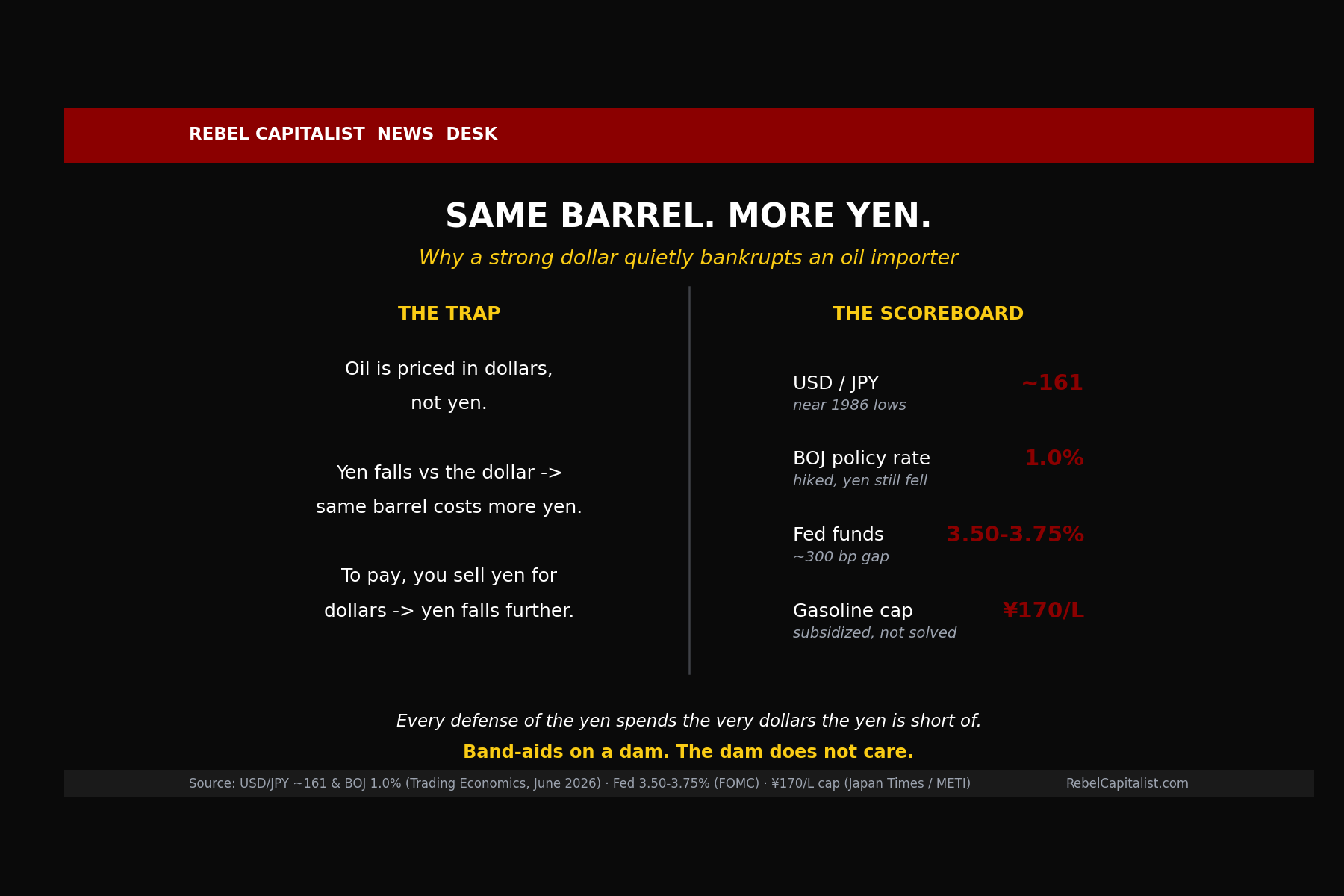
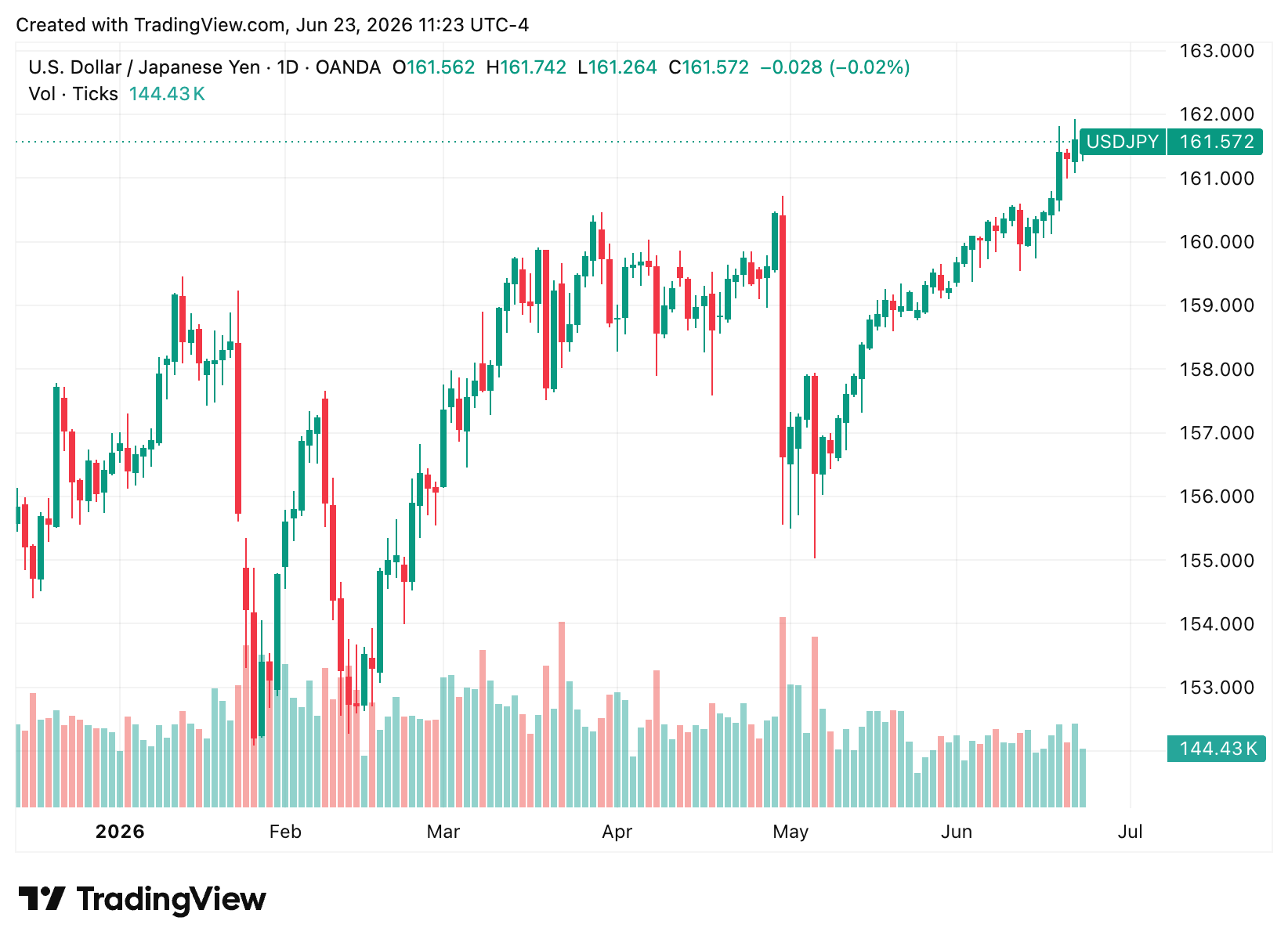
That’s not a theory. That’s USD/JPY pinned near 161 right now, hovering at levels not seen since 1986.
Watch Them Fight The Tide And Lose
Japan’s authorities aren’t sitting still, which is exactly what makes this such a clean case study in futility.
Every time the yen approaches that 160 line, the Ministry of Finance or the Bank of Japan steps in to defend it. How do you defend a currency? You take your stash of dollar reserves and you sell those dollars to buy yen, the mirror image of the refiner’s problem. You add dollars to the market, you add demand for yen, and for a moment the yen rallies. Back in April, one record-sized intervention briefly yanked the yen sharply higher. And then, like clockwork, it drifted right back to where it started. Every single time. It’s like watching a man bail out a boat with a bucket while the hull keeps taking on water.

So they tried the other lever. On June 16 the Bank of Japan hiked its policy rate to 1.0%, trying to narrow the gap with U.S. rates and make the yen more attractive to hold. The result? The yen kept falling anyway. A rate hike that was supposed to prop up the currency instead read to the market as a flare going up, a signal that says we are getting desperate and we are running low on ammunition. The market faded it instantly.
Why are they running low? Because defending the yen means spending dollar reserves, and the whole reason the yen is under pressure is that the country is short of dollars to begin with. They are burning the exact resource they don’t have enough of. You cannot drain the pond to put out the fire when the pond is what’s on fire.
Then there’s the subsidy. With the war in the Middle East pushing crude higher, retail gasoline in Japan spiked to record highs, and the government stepped in to cap pump prices near 170 yen per liter by paying refiners the difference. Sounds like relief. But ask the obvious question: what are they paying the refiners in? Not dollars. Yen. Which still has to be sold for dollars to buy the next barrel. The subsidy doesn’t fix the dollar shortage, it just moves it onto the government’s tab, and that tab is enormous. Reports peg the program at roughly 600 billion yen a month, with the reserves backing it measured in mere months of runway.
Cracks in the dam, and a finger jammed over each one. A thumb here, an elbow there. It holds, until it doesn’t.
The Sea Peoples Problem
So back to the American who shrugs and says none of this touches him.
Run the history. Around 1200 BC, a confederation of naval raiders the texts call the Sea Peoples tore through the eastern Mediterranean, wrecking coastal cities one after another and pushing inland in a way that helped tip the entire Bronze Age into collapse. They finally reached Egypt, and the pharaoh managed to lure their fleet into the narrow waters of the Nile delta and crush it. Egypt won the battle. Everyone celebrated. The invincible empire had beaten the unbeatable raiders.

And then, over the years that followed, the Egyptian economy unraveled anyway. Why? Because the Sea Peoples had already destroyed Egypt’s trading partners. You can win the fight on your own soil and still lose the economy, because no empire is an island. It runs on the web of partners around it. Take out the web, and the center starves no matter how strong its walls look.
That’s the dollar. The dollar is the Sea Peoples. Right now it’s strong, and that strength is the wrecking ball methodically knocking over the trading partners the U.S. economy depends on. The American who says a weak yen on the far side of the Pacific can’t possibly reach his wallet is the Egyptian behind the pyramids, watching distant cities burn and assuming the empire is immune. It isn’t all-interconnected as a slogan. It’s all-interconnected as a balance sheet. Damage your partners long enough and the damage comes home.
This is why the dollar index touching 101 is not a nothing-burger. It’s the single most underrated story in global macro right now, and it’s barely getting covered.
What Comes Next, And Where The Real Work Lives
Watch three things from here. Watch the 160 line on the yen and how hard, and how often, Tokyo has to fight to defend it. Watch whether the Bank of Japan gets dragged into more hikes it clearly doesn’t want. And watch the dollar index itself, because the higher it grinds, the more strain it loads onto every dollar-borrower and every oil-importer on the planet. The pressure doesn’t stay in Tokyo. It travels.
Here’s the honest part. This post lays out the mechanism. It does not lay out the trades, the levels, the specific dominoes, or what a real dollar reversal would have to look like before it’s worth acting on. That’s deliberate. That’s the line between the free desk and the paid one.
Free subscribers get the map: the framework, the why, the mental model that lets you see what financial TV refuses to connect.
Paid subscribers get the territory. Every week, the full breakdown of which economies are closest to the edge of this exact dollar trap and why. The specific levels to watch on the dollar index, USD/JPY, and the crosses that matter, with the reasoning spelled out, not just a headline. The “lines in the sand” that would flip this thesis, so you know in advance what would prove it wrong instead of finding out the hard way. And the way these macro currents translate into actual portfolio positioning, the part that turns a good story into a decision.
The free post tells you the Sea Peoples are coming. The paid desk tells you which walls are about to fall, and when to stop assuming you’re safe behind the pyramids.
If you’ve been reading along and nodding, you already think like a paid subscriber. Make it official. Upgrade, and get the half of the analysis that actually moves the needle.
Facts > Narrative. Always.
Stand up for freedom, liberty, and free market capitalism.

Rebel Capitalist writes "Two Dollars, And Only One Of Them Is In The News" Indeed, the dollar that this article talks about is the dollar that the uberwealthy use to trade globally. The dollar that the rest of us use is the dollar not talked about in this article. Whether it was Greenspan, Bernanke, Yellen, or Powell they all told you that the national debt would be paid off with inflation devalued dollars and the climbing nominal GDP growth would be funded through monetary expansion. That is exactly what the privately owned Federal Reserve Bank has accomplished. The period post 2007 has generated huge winners and huge losers. My only hope is that I am still alive and able to shoot straight when FED and Congress are no longer able to keep the pitchforks from coming out.